BT Share Dividend:
How To Create True Passive Income
From The Giant Digital Landlord
Why Is BT Share Dividend Considered A Defensive Utility Payout?
To understand why BT is one of the most reliable defensive stocks on the London Stock Exchange, we need to look at what the company actually does. Many people think of BT simply as the company that sends them their monthly mobile or broadband bill. But the reality is far more interesting and far more profitable for income-focused investors. At its core, BT is a giant digital landlord. Through its subsidiary, Openreach, BT owns the physical pipes, copper lines, telephone exchanges, and ultra-fast fibre cables that connect almost every home, school, office, and business in the United Kingdom to the digital world. Think of Openreach as a national digital toll bridge. Whether a household gets their monthly broadband connection from BT directly, or gets it from TalkTalk, Sky, or Vodafone, those competitor companies still have to pay a rental fee to BT to use Openreach's physical network to deliver their services. This gives BT an incredibly powerful near-monopoly on the country's fixed-line infrastructure. For an income-focused investor, this infrastructure network is an absolute goldmine. It creates what legendary investor Warren Buffett calls a "regulatory moat." Because laying thousands of miles of physical cables underground, digging up streets, and connecting every single house in the country is incredibly expensive and logistically disruptive, it is highly unlikely that any competitor will ever come along and build a rival national fixed-line network from scratch. Also, telephone and internet subscriptions are incredibly "sticky" recurring revenues. When inflation bites and families are forced to tighten their belts, they do not cancel their internet. They need it to live and work. Because BT boasts a massive 30% market share in the UK broadband and mobile consumer market, this translated into a total group revenue of £19.65 billion for the fiscal year ending 31 March 2026. This stable, defensive revenue stream is the foundational engine that powers BT share dividend year after year. Let's look at how this consumer business compares to BT's other business lines. In 2026, while BT's business segment generated £5.75 billion in turnover (down from £8.42 billion in 2025), and its Openreach segment generated £8.29 billion in turnover (up from £8.15 billion in 2025), its consumer segment stood incredibly firm at £10.42 billion (only a tiny hair below the £10.51 billion in 2025). This demonstrates that even when businesses cut back on their telecommunications spending during economic transitions, everyday UK consumers continue to pay their broadband and mobile bills on time, every time. When you buy BT shares, you are essentially buying a piece of the physical nervous system of the British economy. Every time someone in the UK sends an email, streams a movie, makes a Zoom call, or sends a text message, there is a very high chance that the data is traveling through cables owned and maintained by BT. This infrastructure-backed security is what makes BT share dividend such a comforting prospect for your peace of mind.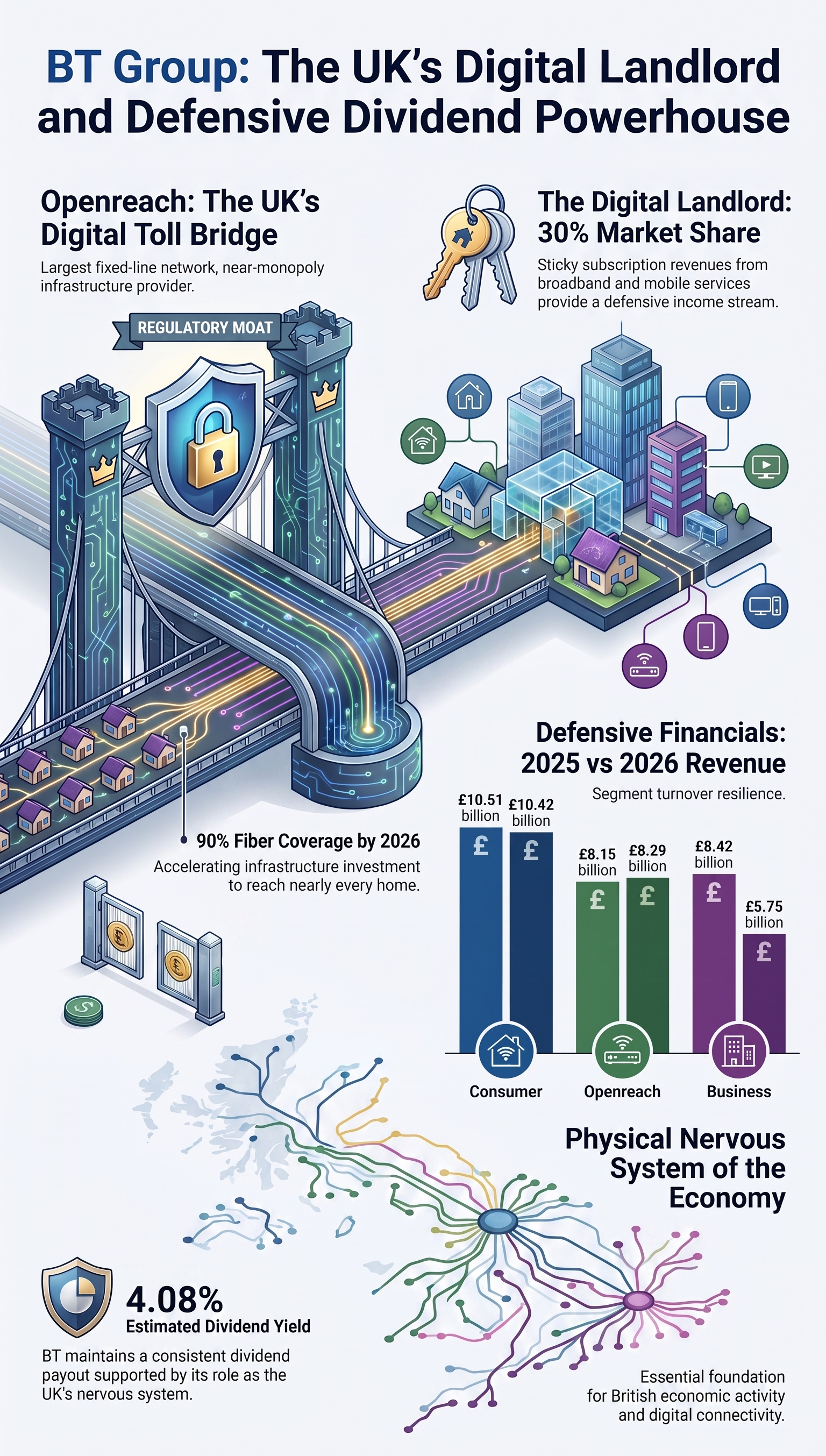
How Safe Is BT Share Dividend? The Crucial Financial Health Indicators
As a seasoned dividend investor, I have learned that a high yield is meaningless if the company cannot sustain it. If a firm cuts its payout next year because it runs out of cash, your investment thesis crumbles. To evaluate the safety of BT share dividend, we must look at three crucial financial health pillars... dividend cover, cash flow, and earnings per share (EPS).1. The Safety Buffer: Understanding BT's Dividend Cover
Think of dividend cover as your financial margin of safety. It is a simple ratio that tells us how many times over a company's annual profits can pay for the dividend it has promised to shareholders. If a company has a dividend cover of 1.0x, it means they are paying out 100% of their profits as dividends. There is absolutely no room for a slip-up. If profits drop by even a single penny, the dividend has to be cut. On the other hand, if a company has a dividend cover of 2.0x, it means they are only paying out 50% of their profits, giving them a healthy buffer to absorb any unexpected business shocks. According to BT's official financial reports for the fiscal year ending 31 March 2026, the company's dividend cover stands at a reassuring 1.32x. This is a steady continuation of its historical safety levels, having recorded a cover of 1.31x in 2025 and a tight 1.12x in 2024. Imagine you run a local bakery. After paying for flour, sugar, electricity, and your staff's wages, you are left with £132 in net profit. If you decide to pay yourself a personal dividend of £100, you still have £32 left over to keep in the bakery's cash register for a rainy day or to buy a new oven. That is exactly what BT is doing. They are generating more than enough profit to cover their dividend payments while retaining a healthy chunk of change to reinvest back into the business. What is particularly encouraging is that BT's dividend cover has recovered dramatically from its 2024 low of 1.12x. In 2024, high costs and inflation put a temporary squeeze on earnings, making the dividend payout feel tight. By 2025, cover improved to 1.31x, and in 2026 it reached 1.32x, proving that management is highly committed to keeping the dividend on a sustainable, upward trajectory without overstretching the balance sheet.2. The Ultimate Truth: Tracking Free Cash Flow And Operating Cash Flow
While paper profits can sometimes be distorted by complex tax rules and depreciation adjustments, cash is absolute king. You cannot pay a dividend to shareholders using paper promises... you must pay them in cold, hard cash. Therefore, we must inspect BT's cash statement to see if they are genuinely pulling in more cash than they are spending. For the fiscal year ending 31 March 2026, BT generated an operating cash flow of £7 billion, continuing an upward trend from £6.95 billion in 2025 and £6.01 billion in 2024. What makes this cash generation so impressive is that BT is currently in the middle of a massive, once-in-a-generation capital expenditure campaign. The company spent £3.77 billion on investing activities in 2026 (primarily laying ultra-fast fibre broadband across the UK). Despite this multi-billion-pound investment, the underlying core business is so cash-rich that it easily supports both the network rollout and the cash cost of the dividend, which amounted to £807 million in ordinary dividends paid out during the 2026 fiscal year. In cash flow terms, let's look at the "net change in cash" for BT. In 2026, BT recorded a net increase in cash of £152 million. This is a massive turnaround from previous years when cash reserves were drawn down to fund the heavy fibre rollout. In 2025, BT saw a net cash reduction of -£133 million, and in 2024, it was a flat -£17 million. The fact that BT has now transitioned back into generating positive net cash after all its massive investing activities is a major green flag for dividend safety.3. Dividend Per Share And Earnings Consistency
For the fiscal year ending 31 March 2026, BT declared a total dividend per share of 8.21p (£0.0821). This payout represents a steady progression from the 8.09p (£0.0809) paid in 2025 and the flat 7.70p (£0.077) paid in both 2024 and 2023. This payout is backed by a reported earnings per share (EPS) of 10.80p (£0.1080) and a normalized diluted EPS of 16.54p (£0.1654). Because the reported earnings per share of 10.80p (£0.1080) easily exceeds the dividend per share of 8.21p (£0.0821), you can rest easy knowing that the company is not borrowing money or stripping its assets just to keep its shareholders happy. If we look at BT's EBITDA (Earnings Before Interest, Taxes, Depreciation, and Amortization), we see a highly stable upward trend. In 2022, BT's EBITDA was £7.19 billion; in 2023, it rose to £7.38 billion; in 2024, it was £7.12 billion; in 2025, it reached £7.47 billion; and in 2026, it hit a record £7.51 billion. This steady rise in underlying cash profitability is the ultimate guarantee of the long-term sustainability of BT share dividend. EPS (Earning Per Share) is calculated by taking a company's total net profit and dividing it by the total number of shares in existence. It tells us exactly how much profit "belongs" to each individual share that you own. In the case of BT, the company reported an EPS of 10.80p (£0.1080) for 2026. Since the dividend per share is 8.21p (£0.0821), this means that for every share you own, BT earned 10.80p (£0.1080) in profit and chose to distribute 8.21p (£0.0821) of that to you as a cash dividend, keeping the remaining 2.59p (£0.0259) inside the company. This retained profit of £270 million is crucial because it acts as a savings account for the company. Now let's look at BT's normalized diluted EPS, which was 16.54p (£0.1654) in 2026. "Normalized" earnings are a way of looking at a company's underlying, ongoing profitability by stripping out "one-off" or exceptional expenses that are unlikely to repeat. For instance, BT had one-off exceptional items of -£771 million in 2026. When we look at the normalized EPS of 16.54p (£0.1654), we see that the core business is actually even more profitable than the standard reported numbers suggest. This gives us an even larger true margin of safety, with a normalized dividend cover of over 2.01x (16.54p normalized earnings divided by 8.21p dividend)! This is an incredibly reassuring buffer for defensive income investors.Why BT Share Dividend Is Perfect For A Stocks And Shares ISA
If you are a UK taxpayer, you must always think about the taxman before you invest. If you buy BT shares through a standard, taxable dealing account, your dividend income above the tiny tax-free dividend allowance will be hit with dividend tax. Over a retirement journey, those tax payments can act like a slow, silent leak in your retirement boat, draining tens of thousands of pounds from your compound interest snowball. The solution to this challenge is simple... you should always purchase your shares of BT.A inside a Stocks And Shares ISA.How The ISA Shield Protects Your BT Share Dividend Payouts
Under current UK rules, a Stocks And Shares ISA allows you to invest up to £20,000 each tax year. The magic of the ISA wrapper is that it acts as an impenetrable tax shield: Zero Dividend Tax: Every single penny you receive from BT share dividend inside your ISA is 100% tax-free. It does not matter if you receive £10 or £10,000 a year in passive income; you do not have to pay a single penny of tax to HMRC, and you do not even need to declare it on a self-assessment tax return. Zero Capital Gains Tax: If BT's share price rises over the long term and your initial investment doubles or triples in value, you can sell your shares and withdraw your cash completely free of capital gains tax. Imagine you are in the higher-rate tax bracket. If you hold BT shares outside of an ISA and receive £5,000 in dividends, you could face a hefty dividend tax bill of 33.75% on everything above your allowance. That is over £1,500 handed straight to the government! But inside your Stocks And Shares ISA, that entire £5,000 stays in your pocket, ready to be reinvested into more shares. For anyone looking to construct an income-producing retirement portfolio, maximizing your ISA allowance should be your absolute priority. It is the single most effective way to turn BT share dividend into a pure stream of tax-free passive income. When you receive dividends outside of an ISA, the first £500 you receive is tax-free. However, any dividend income you receive above that £500 threshold is taxed at your marginal rate (8.75% for basic rate, 33.75% for higher rate, and 39.35% for additional rate). By holding your BT shares inside a Stocks And Shares ISA, you legally bypass this tax completely, saving tens of thousands of pounds over a long-term retirement timeline.How To Compound Your Wealth Using A Dividend Reinvestment Plan (DRIP)
When you are in the "wealth accumulation phase" meaning you are still working and saving for your future retirement you do not actually need to spend the dividend income you receive. Instead of taking your BT share dividend as cash and letting it sit idly in your bank account, you should look into a dividend reinvestment plan (DRIP).The Snowflake Analogy of Compound Interest And BT Share Dividend Growth
To understand how a DRIP works, think of your investment portfolio as a small snowball sitting at the top of a snow-covered hill. If you take your dividend cash out of the portfolio every time it is paid, the snowball stays the same size. But if you use a DRIP, your investment platform will automatically use your dividend cash on the payment date to buy more fractional shares of BT. Because you now own more shares, the next time BT pays a dividend, you will receive an even larger payout. This larger payout is then used to buy even more shares, which in turn generate even more dividends. Over 10, 15, or 20 years, this compound feedback loop creates a massive snowball effect. Let's look at how this compounding works in practice: Imagine you start with a holding of BT shares, say 25,000 shares, purchased at a mid-market price of 205p (£2.05) per share, representing a total investment of £51,250. In the first year, BT pays its annual dividend of 8.21p (£0.0821) per share. This means you will receive a massive cash payout of £2,052.50. Instead of taking this cash and spending it, your DRIP automatically uses this cash on the payment date to purchase more BT shares. At the purchase price of 205p (£2.05), your £2,052.50 buys you an additional 1,001 shares. Now, in year two, you own 26,001 shares! When the next dividend is paid, assuming management keeps the payout flat at 8.21p (£0.0821), you will receive £2,134.68... an extra £82.18 of completely free passive income generated simply because you chose to reinvest. If you let this loop repeat for 15 years, your shareholding will have grown to over 45,000 shares, and your annual dividend income will have risen to over £3,700, without you ever adding another single penny of your own money! This is the raw power of compounding BT share dividend. When you reinvest your dividends through a DRIP, you are participating in a process known as "pound-cost averaging". Because your broker automatically buys more BT shares with your dividend cash on the payment date, you will naturally buy more shares when the stock price is low, and fewer shares when the stock price is high. This helps smooth out the volatility of the Stock Market and ensures that you are constantly building your shareholding at an attractive average price.
How BT Compares To Other FTSE 100 Income Stocks
To put BT share dividend into context, it helps to compare it to the wider UK Stock Market. The London market is world-famous for its high-yielding, dividend-paying companies. But not all FTSE 100 income stocks are created equal. Many of the highest-yielding companies in the FTSE 100 are mining conglomerates, oil supermajors, or cyclical housebuilders. While these businesses can pay enormous dividends during economic booms, their cash flows are highly volatile. When the global price of commodities or property falls, their profits plummet, and their dividends are often slashed overnight. BT operates in a completely different universe. Because its revenue is based on monthly broadband and mobile subscriptions, its cash flow is incredibly smooth, predictable, and resilient. Whether the global economy is booming or not, people still pay their internet bills. This makes BT one of the ultimate "defensive" businesses on the market, offering a level of income stability that cyclical commodity companies can simply never match. BT's dividend has shown incredible stability. Apart from a necessary restructuring pause, BT's dividend has grown or remained steady, rising from 7.70p (£0.077) in 2023, to 8.09p (£0.0809) in 2025, and reaching 8.21p (£0.0821) in 2026. This is exactly the kind of predictable, reliable income that you want when building a defensive retirement portfolio. For a retiree who depends on their dividend income to pay for groceries, utility bills, and heating, this predictability is worth its weight in gold. It does not matter if there is an economic boom or a severe downturn; people still need to make phone calls, send emails, watch television, and connect to the internet. This makes BT's revenue stream incredibly stable and non-cyclical, establishing a resilient cash cushion.What Are The Real-World Risks To BT Share Dividend?
No honest financial guide would ever tell you that an investment is 100% risk-free. Every stock has its vulnerabilities, and as a smart investor, you must weigh the potential rewards against the real-world risks before putting your hard-earned money on the line. When it comes to BT, there are three main risks that you need to keep a close eye on:1. The Mountain of Capital Expenditure (Capex)
BT is currently spending billions of pounds laying physical fibre cables across the UK to replace the old, legacy copper network. This is an incredibly capital-intensive process. For the fiscal year ending 31 March 2026, BT's investing activities cost the company £3.77 billion. While this fibre network is an asset that will generate stable cash flows for the next fifty years, the high cost of building it leaves less spare cash in the short term. Fortunately, BT is nearing the end of its peak capex cycle. Openreach expects to have 90% of the UK covered with Fibre-to-the-Home (FTTH) by 2026. Once the physical cables are laid in the ground, BT's capital expenditure requirements will drop dramatically, freeing up huge amounts of cash flow that can be returned to shareholders in the form of higher dividends.2. The Heavy Debt Burden And Rising Interest Rates
Building national telecommunications networks requires a lot of upfront funding, and BT has taken on a significant amount of debt to finance its operations. As of 31 March 2026, BT's total borrowings stood at £22.72 billion. Because the company has a high level of gearing, it must pay a substantial amount of interest to its lenders every year. In the 2026 fiscal year, BT's net interest expense was £1.08 billion. Fortunately, BT's operating profits are large enough that its interest cover stands at a sustainable 2.17x. This is an improvement from 2.06x in 2025 and 2.03x in 2024, showing that the interest burden is highly manageable. However, if interest rates remain high for an extended period, the rising cost of refinancing this debt could eat into the company's net profits and threaten the dividend payout.3. The Watchful Eye of Ofcom
Because BT owns the physical network infrastructure that its competitors rely on, it is heavily regulated by Ofcom. Ofcom constantly monitors BT to ensure that it does not take advantage of its monopoly power or charge unfair wholesale prices to competitors. For example, regulatory news highlights that Ofcom sometimes proposes blocking certain pricing deals offered by Openreach (such as new wholesale discount packages for retail providers) to prevent anti-competitive behavior. If Ofcom introduces new regulations that force BT to cut the rental fees it charges to other broadband providers, it would directly impact BT's revenues and cash flows, potentially restricting future dividend growth. While £22.72 billion in borrowings is a massive figure, BT's physical infrastructure assets are worth £49.97 billion. Combined with an operating profit of £3.53 billion and over £21 billion of debt structured as long-term borrowings due in over 5 years, the interest coverage ratio of 2.17x indicates that BT's use is highly manageable.Does BT Share Dividend Belong In Your Retirement Portfolio?
When you strip away all the complex financial jargon, dividend investing is about one simple thing... ...buying assets that generate reliable cash flow so you can buy back your time and achieve financial independence. BT share dividend is not going to make you rich overnight. This is not a high-flying tech stock that will double in value in a matter of weeks. But what it will do is act as a reliable workhorse for your retirement portfolio. Supported by a massive national monopoly on physical broadband infrastructure, a stable subscription-based business model, a healthy dividend cover of 1.32x, and a highly attractive tax-free yield of 4.08% - 4.13% inside a Stocks And Shares ISA, BT represents one of the most dependable defensive income opportunities in the UK market today. If you are looking to step off the Stock Market rollercoaster and build a predictable, resilient stream of passive income that can weather any economic storm, it is time to give BT share dividend a permanent home in your investment strategy. BT is a classic example of such a business. It is a digital landlord with a near-monopoly on the physical broadband cables of the UK. Through open and volatile market cycles, its subscription-style revenues stand strong, making BT share dividend one of the most reliable and attractive income opportunities on the London Stock Exchange today. By using a tax-free Stocks And Shares ISA to shield your payouts, and a dividend reinvestment plan (DRIP) to compound your holdings, you can turn this defensive utility stock into the primary engine of your retirement wealth strategy.Frequently Asked Questions About BT Share Dividend
What is the current dividend yield of BT share dividend?
How much dividend per share did BT pay for the 2026 fiscal year?
Is BT share dividend covered by its earnings?
Can I buy BT shares tax-free in the UK?
Does BT offer a Dividend Reinvestment Plan (DRIP)?
How often are BT dividend payments paid out to shareholders?
What is BT's ticker symbol on the London Stock Exchange?
What was BT's total cash flow from operations in 2026?
What are the primary risks that could lead to a cut in BT dividend?
What is BT's market share in the UK broadband market?
| 💡 Key Takeaways |
|---|
| BT functions as a highly resilient defensive utility because broadband and mobile services are non-discretionary necessities that households continue paying for during economic downturns, establishing a strong foundation for BT share dividend. |
| The company offers an attractive and competitive estimated dividend yield, providing income-focused investors with a steady and reliable return compared to volatile, cyclical assets. |
| The underlying safety of the shareholder distribution is backed by a stable dividend cover ratio, which has demonstrated consistent, reassuring year-on-year stabilization. |
| BT's business operates as a massive cash-generating machine, producing strong operating cash flow that comfortably supports its ongoing infrastructure investments and regular dividend payments. |
| The business maintains a clear commitment to shareholder returns, delivering steady, progressive growth in its annual dividend per share over recent financial periods. |
| To shield your passive income from the UK tax authorities, you should hold your shares of BT.A inside a tax-efficient wrapper like a Stocks And Shares ISA. |
| Holding BT shares in a Stocks And Shares ISA ensures that all received distributions and capital gains remain entirely free from UK tax, helping you preserve your returns. |
| Reinvesting cash distributions through a dividend reinvestment plan (DRIP) accelerates the compounding snowball effect, enabling your portfolio to acquire additional shares that generate progressively larger future returns. |
| A core structural advantage is BT's complete ownership of Openreach, which acts as a national digital toll bridge that competitor telecommunications networks must rent to deliver broadband services. |
| While BT represents one of the premier defensive stocks for an income-focused retirement portfolio, you must carefully monitor long-term risks such as its high total borrowings, ongoing capital expenditure demands, and regulatory oversight from Ofcom. |