Mastering The Art of
Calculating Dividend Yield:
An Ultimate Guide To Building
Passive Cash Flow
How Is Calculating Dividend Yield The First Step In Smart Income Investing?
To put it in the simplest possible terms, calculating dividend yield is the process of determining the annual return on your stock investment based solely on the cash payouts you receive from the company, represented as a percentage of the stock's current price. It acts as a financial translator, turning absolute dividend payments into a standard percentage rate that allows you to compare different shares on an equal footing. Think of it as the interest rate on a savings account, but with the potential for both the income and the underlying capital to grow over time. When you deposit money into a high-street bank, they promise to pay you a certain percentage of interest each year. In the Stock Market, when you buy shares in a dividend-paying business, that business distributes a portion of its earnings back to you. The dividend yield is simply the mathematical relationship between the cash you receive and the price you paid to acquire those shares. For any investor looking to make money from the Stock Market, especially through income investing, this percentage is your north star. It tells you exactly how much cash flow your portfolio is generating relative to its market value. In a world where share prices move up and down on a daily basis, dividend payments provide a steady, tangible return that does not rely on selling your shares to book a profit. It is a powerful psychological anchor... Even when the Stock Market is experiencing a temporary downturn, you can watch your dividend payments roll in, knowing that your income stream remains intact.Why Calculating Dividend Yield Matters For Building Passive Wealth
Why should you care about calculating dividend yield? Why not simply focus on finding the next high-flying tech giant that promises to double its stock price in a few months? The answer lies in the fundamental difference between capital appreciation and consistent cash flow. Relying solely on stock price increases means you are at the mercy of market sentiment. If you need money during a market downturn, you might be forced to sell your shares at a massive discount just to cover your living expenses. Dividend investing flips this script on its head. When you focus on high-quality dividend stocks, you are investing in mature, stable companies that have transitioned from rapid expansion to reliable profitability. These businesses generate more cash than they can reasonably reinvest in their daily operations, so they choose to return a substantial portion of that cash to their owners you, the shareholder. By focus-firing your strategy on calculating dividend yield, you can construct a portfolio designed to produce regular, predictable income. Also, analysing this metric is the key to comparing vastly different investment opportunities. For example, if Stock A trades at £20 and pays an annual dividend of £1, and Stock B trades at £100 and pays an annual dividend of £4, which one is the better income generator? Without calculating dividend yield, it is incredibly challenging to tell. By converting these raw numbers into percentages, you can instantly see that Stock A offers a 5% yield, while Stock B offers a 4% yield.| Stock | Share Price | Annual Dividend | Dividend Yield |
|---|---|---|---|
| Stock A | £20.00 | £1.00 |
5.0% (1 / 20) x 100 |
| Stock B | £100.00 | £4.00 |
4.0% (4 / 100) x 100 |
|
Better income generator: Stock A While Stock B pays a higher absolute dividend (£4 vs £1), Stock A delivers a higher yield (5% vs 4%) meaning you get more income per pound invested. For income investors, yield is the key metric. |
|||
The Core Formula: Step-By-Step Guide To Calculating Dividend Yield
Now that we understand why this metric is so vital, let us roll up our sleeves and look at the mathematical engine behind it. Do not worry you do not need a degree in advanced mathematics to master this. In fact, if you can perform basic division on your smartphone, you already have all the technical skills required for calculating dividend yield. The fundamental formula for calculating dividend yield is:
1. Annual Dividend Per Share
This is the total amount of cash a company pays you for every single share you own over the course of a full year. Since most UK companies distribute their dividends semi-annually (twice a year) or quarterly (four times a year), you will need to sum these individual payments or annualise the latest payment to find the annual figure.2. Current Share Price
This is the market value of a single share of the stock at the exact moment you are performing the calculation. Because Stock Markets are open throughout the business day, this number is constantly moving. So, calculating dividend yield produces a dynamic figure that fluctuates in real-time as the stock price rises and falls. To make this completely crystal clear, let us look at a simple, real-world analogy... The Dynamic Savings Account. Imagine a unique high-street savings account that pays a guaranteed cash reward of exactly £5 cash to the account holder at the end of every year. However, unlike a standard bank account, the "entry fee" required to buy or open this account changes every single day based on supply and demand: Buying in at £100: If you open this account today when the entry fee is £100, your cash return rate or your calculated dividend yield is 5% (£5 annual reward divided by £100 entry cost). Buying in at £50: If the account falls out of favour and the entry fee drops to £50 tomorrow, a new saver buying in secures a yield of 10% (£5 reward divided by £50 entry cost). Buying in at £200: If massive hype drives the entry fee up to £200, a new buyer only secures a yield of 2.5% (£5 reward divided by £200 entry cost). Calculating dividend yield in the Stock Market operates on this exact principle. The company's annual dividend is the fixed cash reward (£5), the stock's current share price is the daily fluctuating entry fee, and the dividend yield is your starting rate of cash return. Even if the cash payout remains completely stable, the yield changes every second because the cost to buy that cash stream fluctuates with the market.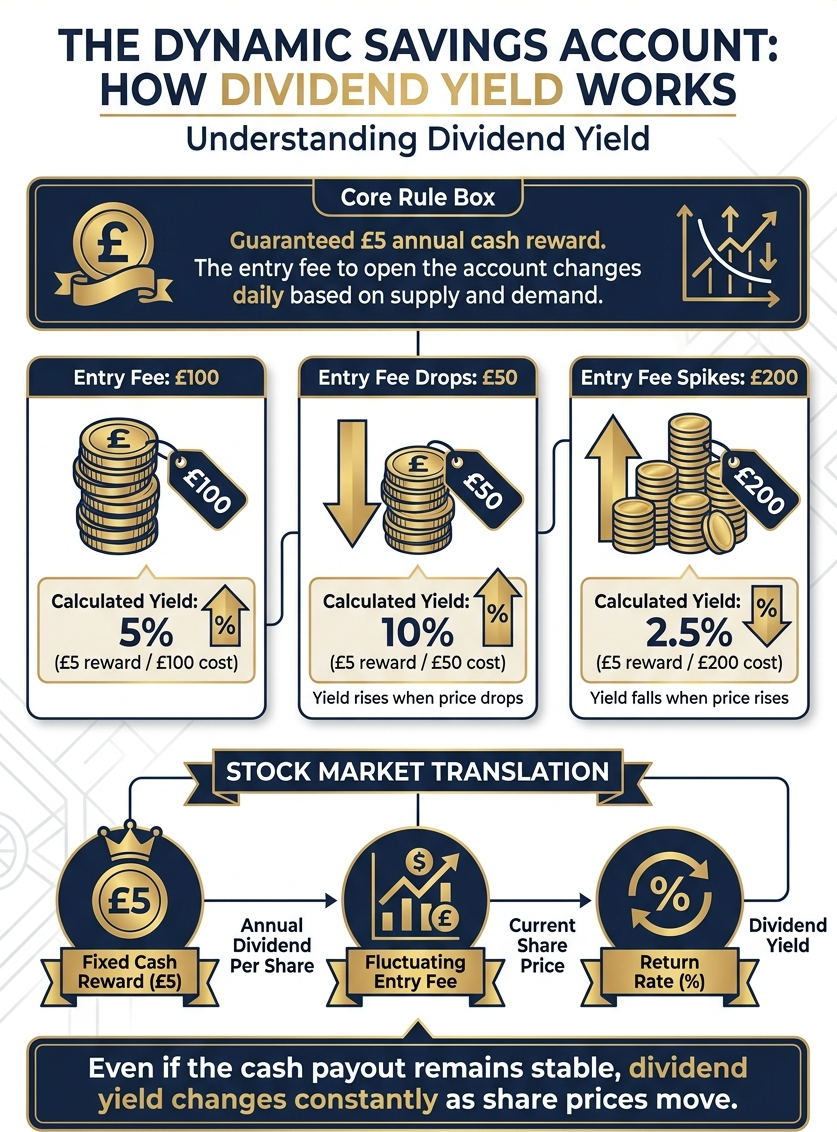
Applying The Formula of Calculating Dividend Yield To A Stable Business: The Earl's Reserve Tea Company
Let us bring this formula to life using a fictional example of a stable, long-established British business... The Earl's Reserve Tea Company. Imagine this company is a beloved household brand that has been blending premium tea leaves for decades. Because tea consumption is incredibly steady regardless of economic conditions, the company enjoys predictable profits year after year. Let us assume that the current share price of The Earl's Reserve Tea Company on the London Stock Exchange is exactly £10. Over the past twelve months, the company has declared and paid two semi-annual dividends:- An interim dividend of £0.20 per share in October.
- A final dividend of £0.30 per share in April.
Annual Dividend Per Share = £0.20 + £0.30 = £0.50
Now, we can apply our formula for calculating dividend yield:Dividend Yield = 0.50 10.00 x 100 = 5%
| Component | Description | Example |
|---|---|---|
| Annual Dividend Per Share | Total cash dividends paid per share over one year | £0.50 |
| Current Share Price | The market price of one share today | £10.00 |
| Dividend Yield | The percentage return from dividends alone |
5.0% (0.50 / 10.00) x 100 |
|
Formula: Dividend Yield (%) = (Annual Dividend Per Share / Current Share Price) x 100
Result: (0.50 / 10.00) x 100 = 5.0% |
||
Applying The Formula of Calculating Dividend Yield To A Growing Chain: The Froth House Coffee Co.
Now, let us examine a different kind of business... The Froth House Coffee Co., a rapidly expanding chain of artisanal coffee shops. Because this company is still opening new locations, it reinvests a larger portion of its profits back into the business, but it still pays a modest dividend to keep its income-seeking shareholders happy. Let us assume that the current share price of The Froth House Coffee Co. Is £40. Unlike our tea blender, this coffee company pays its dividends quarterly. The board has recently declared a quarterly dividend of £0.20 per share. To calculate the annual dividend per share, we must annualise this quarterly payment by multiplying it by four (since there are four quarters in a year):Annual Dividend Per Share = £0.20 x 4 = £0.80
Now, let us run the calculation to find our dividend yield:Dividend Yield = 0.80 40.00 x 100 = 2%
In this scenario, The Froth House Coffee Co. Offers a 2% dividend yield. While this is lower than the 5% yield offered by the tea company, it represents a very different type of investment opportunity. The coffee company is growing quickly, meaning there is a higher potential for the share price to rise in the future. As an income investor, you must decide whether you prefer the high, immediate cash flow of a 5% yield or the lower 2% yield of a business that might grow its dividends and its share price more rapidly over time.Trailing vs. Forward Yield: Navigating The Timing Elements In Calculating Dividend Yield
As you begin searching for dividend stocks on financial websites or brokerage platforms, you will quickly notice that the reported dividend yield can vary depending on which platform you use. This is not because the platforms are not good at maths... Rather, it is because there are different conventions for determining the "annual dividend" part of our formula. To be a successful investor, you must understand the difference between trailing dividend yield and forward dividend yield. The trailing dividend yield is a historical lookback. It takes the actual dividends paid by the company over the previous twelve months and divides them by the current stock price. This is a very safe and conservative calculation because it is based on cold, hard historical cash. It shows you exactly what the company has paid. However, the Stock Market is inherently forward-looking. What a company paid last year does not guarantee what it will pay next year. This is where the forward dividend yield comes into play. It takes the most recently announced dividend payment, annualises it... E.g. Multiplies a quarterly payment by four, or a semi-annual payment by two... And divides that figure by the current stock price. This calculation reflects what the company expects to pay over the coming year, assuming the dividend rate remains unchanged. Let us return to our tea brand... The Earl's Reserve Tea Company... To see how these two metrics can diverge. Imagine The Earl's Reserve Tea Company is doing exceptionally well and thanks to a surge in demand for premium loose-leaf tea, the board decides to reward shareholders by raising the upcoming semi-annual dividend from £0.25 to £0.35. If we calculate the trailing yield, we are still looking at the last two payments of £0.20 and £0.30, giving us our historical 5% yield on the £10 share price. But if we look at the forward yield, we take the new £0.35 payment, multiply it by two to annualise it to £0.70, and divide by the £10 share price:Forward Dividend Yield = 0.70 10.00 x 100 = 7%
Suddenly, the forward dividend yield has jumped to 7%, while the trailing yield remains at 5%. If you only looked at the trailing yield, you would miss the fact that this company has just become a significantly more attractive income investment. Conversely, if a company is facing issues and announces it is cutting its dividend in half, the forward yield will immediately drop, warning you of the uncertainty, while the trailing yield will still look artificially high and safe for several months. Always check which version of the yield you are viewing, and ideally, calculate both yourself to get the full picture.Yield On Cost: Why Your Personal Experience of Calculating Dividend Yield Changes Over Time
If you want to understand the true magic of long-term income investing, you must learn about a concept known as "yield on cost". While the standard dividend yield we have discussed is calculated using the current market price of the stock, yield on cost is calculated using the price you originally paid to buy the shares. The formula for calculating your personal yield on cost is:Yield on Cost = Current Annual Dividend Per Share Your Original Purchase Price Per Share x 100
When you first buy a stock, your yield on cost is exactly the same as the market dividend yield. But if you invest in high-quality companies that consistently grow their dividend payouts year after year, something incredible happens. Your original purchase price remains fixed forever, but the cash payments you receive keep climbing. Over time, your personal yield on cost can reach mind-boggling heights, even if the current market dividend yield of the stock remains modest. Let us illustrate this with our beloved tea company. Imagine that back in 2016, you bought 1,000 shares of The Earl's Reserve Tea Company when the stock was trading at £5 per share. Your total investment was £5,000. At the time, the company paid an annual dividend of £0.25 per share, representing a very respectable 5% dividend yield. Over the next ten years, the company continued to thrive. By 2026, due to steady business growth and mild inflation, the share price had doubled to £10. At the same time, the board steadily increased the annual dividend payout from £0.25 to £0.60 per share. Let us look at how the mathematics of calculating dividend yield works in this scenario: Current Market Dividend Yield: If a new investor walks up to the Stock Market today and buys shares of the tea company at the current price of £10, their dividend yield will be:Current Yield = 0.60 10.00 x 100 = 6%
Your Personal Yield on Cost: Because you bought your shares ten years ago at £5, your personal yield on cost is calculated using your original entry price:Yield on Cost = 0.60 5.00 x 100 = 12%
This is the ultimate prize of income investing! While the rest of the market sees a 6% yield, you are quietly earning a massive 12% annual return on your initial capital. And because you own 1,000 shares, you are now receiving £600 in annual cash flow from an investment that originally cost you £5,000. If the company continues to grow its dividend for another ten years, your yield on cost could easily rise to 20% or 30%. This is how ordinary people build generational wealth. They do not do it by chasing hot stock tips or trying to time the market. They do it by buying great companies at fair prices, holding them for the long term, and letting the compounding power of growing dividends do the heavy lifting.The Safety Net: Distinguishing Calculating Dividend Yield From The Dividend Payout Ratio
At this stage, you might be tempted to load up your brokerage account, run a stock screener, and buy every single company offering a dividend yield of 10%, 15%, or even 20%. It seems like a logical shortcut to wealth, doesn't it? If a 5% yield is good, surely a 15% yield is three times better! Unfortunately, this is the single most common trap in the world of dividend investing. It is a phenomenon known as a "yield trap". To protect your hard-earned money, you must learn to distinguish between calculating dividend yield and analysing the dividend payout ratio. While the dividend yield tells you how much income you will receive relative to the stock price, the dividend payout ratio tells you how sustainable that income actually is relative to the company's profits. It measures the percentage of a company's net earnings that are paid out to shareholders as dividends, rather than being kept to run the business or pay off debt. The formula for the dividend payout ratio is:Dividend Payout Ratio = Annual Dividend Per Share Earnings Per Share (EPS) x 100
Earnings Per Share (EPS) is simply the company's total net profit divided by the number of shares outstanding. It represents the actual pool of money from which dividends are paid. If a company is paying out more than it earns, it is effectively funding its dividend using debt, dipping into savings, or selling off assets. None of these options are sustainable over the long term. Let us explore this crucial concept by looking at three distinct UK businesses... Our stable tea blender, our growing coffee chain, and a third company in serious financial jeopardy.Evaluating Dividend Safety: How Calculating Dividend Yield Compares Across Three Payouts
1. The Earl's Reserve Tea Company (The Steady Performer)
Let us assume this company earns £1.00 per share in profits (EPS) and pays out £0.50 per share in dividends.Dividend Payout Ratio = 0.50 1.00 x 100 = 50%
A payout ratio of 50% is incredibly healthy. It means the company is paying out half of its profits to shareholders and keeping the other half as a safety cushion. If the tea industry experiences a tough year and profits drop by 20%, the company can easily maintain its £0.50 dividend without putting the business at risk.2. The Froth House Coffee Co. (The Growth Champion)
This company is younger and needs cash to build new shops, so it earns £1.60 per share in profits but pays out only £0.80 per share in dividends.Dividend Payout Ratio = 0.80 1.60 x 100 = 50%
Even though this company operates in a more capital-intensive industry than the tea blender, its payout ratio is also a very safe 50%. The board has plenty of room to continue expanding while protecting the current dividend payment.3. The Shiny Tea Kettle Co. (The Deceptive Yield Trap)
Now, let us look at a third business... The Shiny Tea Kettle Co., a company that manufactures old-fashioned copper kettles. Unfortunately, consumers have moved on to modern electric kettles, and sales are falling. The company's share price has fallen from £20 down to just £2. Hoping to stop shareholders from dumping the stock, the board desperately tries to maintain their historical annual dividend of £0.40 per share. If we only focus on calculating dividend yield, this stock looks like an absolute goldmine:Dividend Yield = 0.40 2.00 x 100 = 20%
A 20% annual return! It sounds too good to be true. And as the old saying goes, if it sounds too good to be true, it almost certainly is. Let us look at the company's actual earnings. Because sales have fallen, the company only earns £0.25 per share in profits (EPS). Let us calculate their dividend payout ratio:Dividend Payout Ratio = 0.40 0.25 x 100 = 160%
This is a financial meltdown waiting to happen. The Shiny Tea Kettle Co. Is paying out £0.40 in dividends while only bringing in £0.25 in profits. This means for every share you own, the company is draining £0.15 from its balance sheet to keep up appearances. Very soon, the company's lenders will step in, or the cash reserves will run completely dry. The board will have no choice but to announce a massive dividend cut, or cancel the dividend altogether. When that happens, the remaining shareholders will panic, the stock price will plunge even further, and you will be left with a fallen share price and zero income return. By pairing the process of calculating dividend yield with a quick analysis of the dividend payout ratio, you could have spotted this red flag from a mile away. As a general rule of thumb, look for payout ratios under 60% for most businesses, and under 80% for highly stable utilities or real estate investment trusts. Anything higher should be approached with extreme caution.Reinvesting Your Cash Flow: How Calculating Dividend Yield Fuels Exponential Portfolio Growth
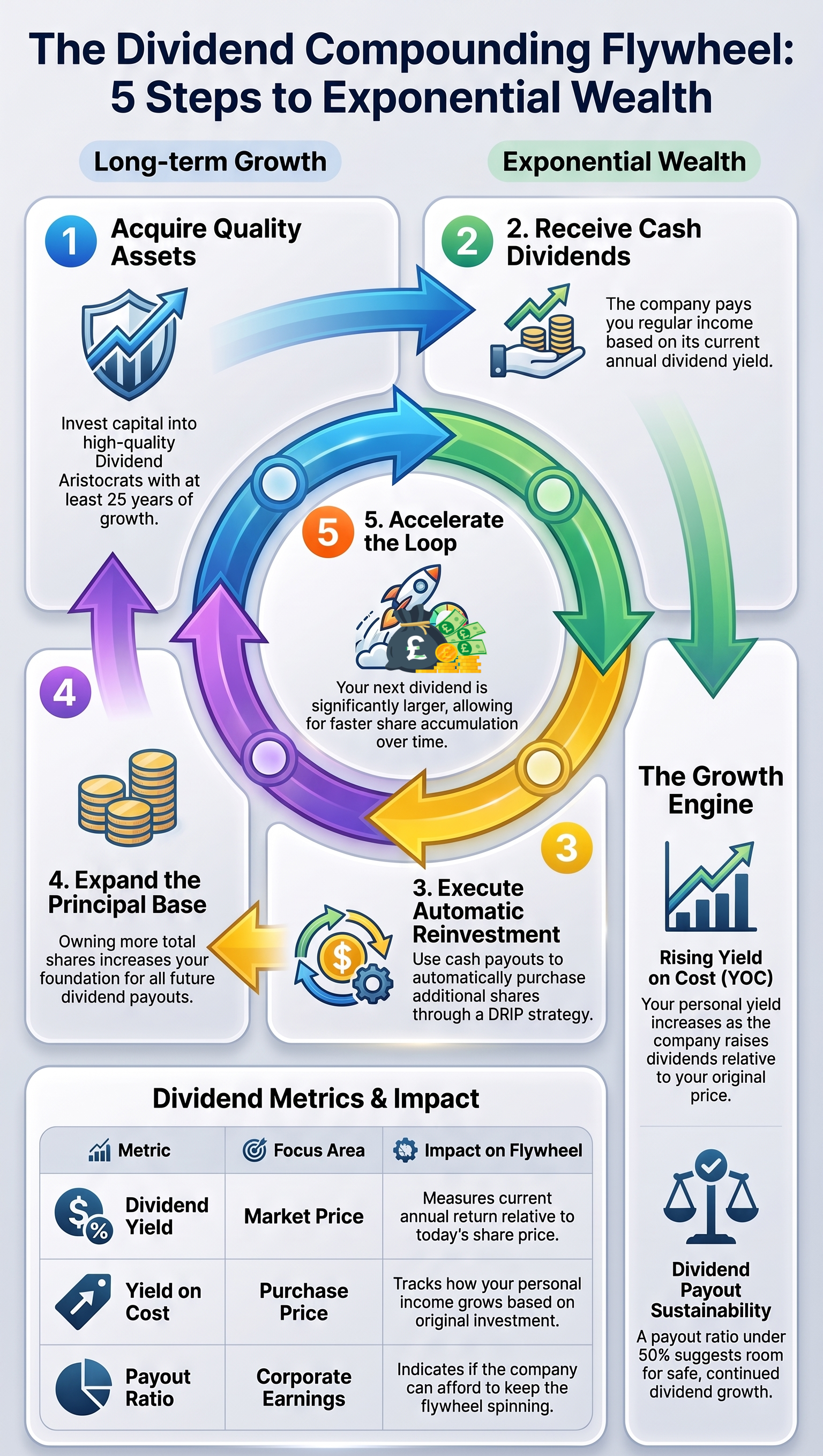
Once you have mastered the basics of calculating dividend yield and identifying safe, sustainable payouts, you are ready to unleash the single most powerful force in the financial universe......compound interest. When your dividend payments arrive in your brokerage account, you have a choice. You can take that cash and spend it on a nice meal, a weekend away, or a new pair of shoes. Alternatively, you can use that cash to buy more shares of the very companies that paid you the dividend. This process is known as dividend reinvestment, and it acts as an accelerator on your wealth-building journey. Imagine you participate in a Dividend Reinvestment Plan (DRIP). Instead of paying the cash into your bank account, your broker automatically uses your dividends to purchase fractional or full shares of the stock. Let us see how this compounding engine works over time:- You buy shares in a company.
- The company pays you a dividend based on its current dividend yield.
- You reinvest that dividend to buy more shares.
- Because you now own more shares, your next dividend payment is larger.
- You use that larger dividend to buy even more shares.
Your Income Investing Roadmap: A Practical Checklist For Calculating Dividend Yield Safely
To help you put everything we have discussed into action, I have put together a simple, practical roadmap you can follow when evaluating any potential dividend stock. Before you press the "buy" button on your brokerage account, run the company through this checklist to ensure you are buying a resilient income generator rather than a deceptive yield trap. 1. Calculate the Dividend Yield: Is the current yield attractive enough to meet your income goals? Is it significantly higher than the market average? If it is over 8%, proceed with extreme caution and investigate why the share price might have fallen. 2. Analyse the Dividend Payout Ratio: Divide the annual dividend by the earnings per share. Is the payout ratio under 60% for a standard business, or under 80% for a utility or REIT? If the payout ratio is over 100%, run away! 3. Examine the Dividend Growth History: Look back over the past five to ten years. Has the company consistently maintained or increased its dividend payout? We love to see a steady upward climb, which signals management's commitment to returning capital to shareholders. Look for dividend aristocrats where possible. 4. Assess the Business's Competitive Advantage: Does the company possess a durable "moat" that protects its profits? Look for strong brand loyalty (like our tea company), essential services, or high barriers to entry. A company with a strong moat can maintain its dividends even during economic downturns. 5. Check the Debt Levels: High debt is the adversary of dividends. If a company is facing issues to make its interest payments, the dividend is always the first thing to be cut. Look for companies with manageable debt-to-equity ratios. By incorporating these simple steps into your investment routine, you will protect your capital, secure your income streams, and build a portfolio of high-quality dividend paying assets that will fund your dreams for decades to come.The Path To Passive Income: Your Next Steps In Calculating Dividend Yield
Building a stream of passive income through the Stock Market is not an overnight event. It is a journey that requires patience, discipline, and a willingness to focus on the long term. But of all the strategies available to everyday investors, dividend investing is perhaps the most accessible and rewarding. By mastering the simple art of calculating dividend yield, you gain the power to evaluate any business, compare opportunities on an equal footing, and take control of your financial future. You no longer have to worry about the daily noise of the financial news or the wild swings of the Stock Market. Instead, you can focus on building a collection of cash-producing assets that work for you day and night. Remember, the best time to start investing was twenty years ago. The second best time is today. Start small, buy quality, reinvest your dividends, and watch as those tiny streams of cash flow merge to form an unstoppable river of wealth. You have the knowledge, you have the formula, and you have the roadmap. Now, it is time to take the first step. Happy investing!Frequently Asked Questions About Calculating Dividend Yield
What is the easiest way to start calculating dividend yield?
Why does the share price affect calculating dividend yield?
Does calculating dividend yield include share price growth?
How often should I update my calculations when calculating dividend yield?
What is a good target when calculating dividend yield for a beginner?
How does the dividend payout ratio protect me when calculating dividend yield?
Is there a difference between trailing and forward methods when calculating dividend yield?
Why do some fast-growing companies have a zero percent result when calculating dividend yield?
How does yield on cost relate to calculating dividend yield?
Can calculating dividend yield help me retire early?
| 💡 Key Takeaways |
|---|
| Mastering calculating dividend yield is the ultimate first step to evaluating the passive income potential of any stock. |
| To perform calculating dividend yield correctly, divide the annual dividend per share by the current market share price and multiply by 100. |
| Since stock prices fluctuate daily, calculating dividend yield produces a dynamic rate that changes in real-time. |
| Never evaluate calculating dividend yield in isolation; always pair it with the dividend payout ratio to assess sustainability. |
| When calculating dividend yield, trailing yield is based on historical payments, while forward yield is based on projected future payments. |
| As companies grow their payouts over time, calculating dividend yield on your original purchase price creates a rising yield on cost. |
| An exceptionally high result when calculating dividend yield is often a yield trap, signifying that the business is in financial jeopardy. |
| Reinvesting cash flows using a Dividend Reinvestment Plan (DRIP) compounds your holdings and accelerates the effect of calculating dividend yield. |
| A safe dividend payout ratio when calculating dividend yield is typically below 60% for standard corporations. |
| Focusing on dividend aristocrats provides stable, reliable dividends that have grown consistently for at least 25 consecutive years. |