How To Build A Passive Income
Stream With A Dividend ETF:
A Comprehensive UK Investor's
Guide To Sustainable Wealth
What Is A Dividend ETF And How Does It Actually Work For Your Portfolio?
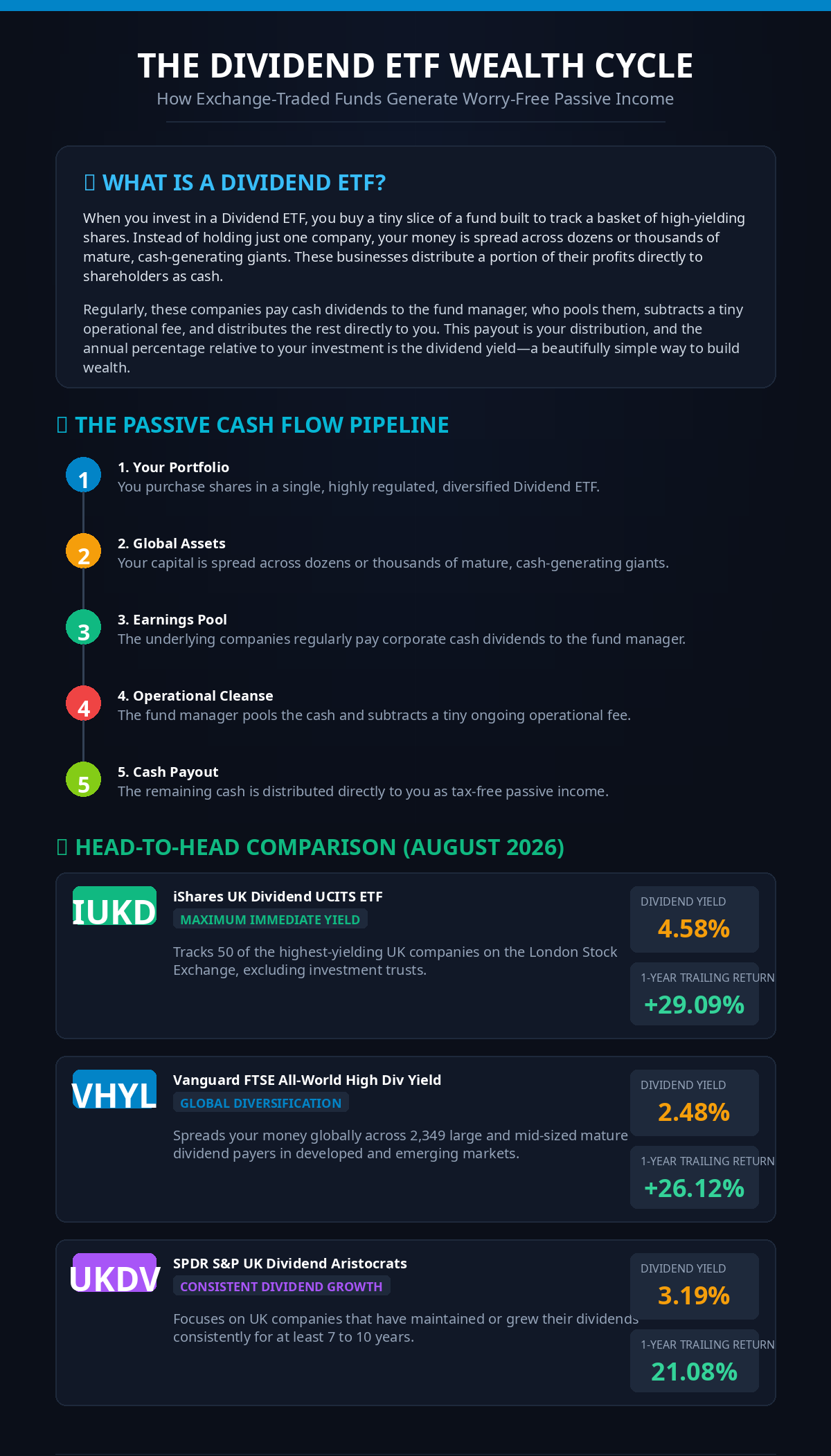
Before we dive in, let me share an analogy that changed how I think about investing. Imagine you want fresh apples every week. You can buy a single tree, research its soil, prune it, and pray that frost doesn't wipe it out. If that single tree doesn't produce, your apple supply drops to zero instantly. Alternatively, you can buy a tiny share in a professionally managed fruit orchard containing thousands of different trees... apples, pears, plums, and cherries. Farmers look after the trees, prune them, and replace any that wither. Every season, the orchard distributes a basket of mixed produce straight to your door. In this scenario, the single tree is an individual stock, the orchard is a Dividend ETF, and the professional farmers are the fund managers. The fruit delivered to your door represents your cash payouts. When you invest in a Dividend ETF, you buy a tiny slice of a fund built to track a basket of high-yielding shares. Instead of holding just one company, your money is spread across dozens or thousands of mature, cash-generating giants. These businesses distribute a portion of their profits directly to shareholders as cash. Regularly, these companies pay cash dividends to the fund manager, who pools them, subtracts a tiny operational fee, and distributes the rest directly to you. This payout is your distribution, and the annual percentage relative to your investment is the dividend yield- a beautifully simple way to build wealth.Why Choose A Distributing Dividend ETF Over An Accumulating One?
When you begin searching for the right Dividend ETF, you will quickly notice that most funds come in two distinct formats... Distributing (often marked as "Dist" or "£ Share Class Dist") and Accumulating (often marked as "Acc"). Understanding the difference between these two is absolutely crucial for your income investing strategy. A "Distributing Dividend ETF" does exactly what it says on the tin... it harvests the cash dividends from the underlying companies and deposits them directly into your investment account as cold, hard cash. This is the choice you want if your primary goal is to generate an active cash flow to cover your living expenses, pay your bills, or fund your lifestyle. It gives you the physical income that you can withdraw and spend. An "Accumulating Dividend ETF", on the other hand, does not pay you cash. Instead, it takes those cash dividends and automatically uses them to buy more shares within the ETF itself. This happens behind the scenes, without you needing to lift a finger or pay trading fees. While you don't receive any cash in your bank account, the value of your overall investment grows at a much faster rate because you are harnessing the raw, compounding power of compound interest automatically. If you are in the "accumulation phase" of your life meaning you are still working, earning a salary, and trying to build up a large nest egg, I highly recommend focusing on accumulating funds or immediately reinvesting the payouts from your distributing funds. However, if you are approaching retirement or simply want to feel the psychological boost of seeing regular cash flow hit your account, a distributing Dividend ETF is your perfect companion.Why Should You Invest In A Dividend ETF Over Picking Individual Stocks As A Beginner?
When I first started my Stock Market journey, I picked individual UK shares which I still do, but I've also come to realise that as a beginner to get started quickly creating a passive income stream, you should at least get started with a Dividend ETF. Here's why a Dividend ETF is almost always a superior choice for a beginner. First and foremost is the concept of instant diversification. When you buy a global Dividend ETF, you are instantly spreading your capital across hundreds of companies in various sectors and countries. If one bank or oil giant in the fund hits a rough patch and cuts its dividend, it represents only a tiny fraction of the overall fund. The remaining hundreds of healthy companies continue paying out, keeping your passive income steady and secure. Secondly, a Dividend ETF saves you time and mental energy. To successfully pick individual income stocks, you must act like a corporate analyst, monitoring their payout ratio and balance sheets. With a Dividend ETF, all of this challenging work is outsourced to the fund manager for a tiny annual fee. This turns investing into a true "set-and-forget" habit, freeing you up to focus on your life, family, and hobbies. Finally, exchange-traded funds offer unmatched cost-efficiency. Buying 50 or 100 individual stocks would require dozens of transaction fees, eating into your starting capital. With a Dividend ETF, you make a single trade, paying little to no transaction fees, and instantly gain exposure to a highly diversified portfolio.Can A Dividend ETF Protect You From The Dreaded Yield Trap?
One of the most treacherous traps in the Stock Market is what I call the "yield trap." It occurs when an individual company boasts an incredibly high dividend yield say, 10% or 12%. To a beginner, this looks like an absolute bargain. But a dividend yield is a mathematical fraction: it is the annual dividend per share divided by the stock price multiplied by 100.How To Spot And Evaluate The Best Dividend ETF For Your Portfolio
Not all exchange-traded funds are created equal. If you type "Dividend ETF" into an investment screener, you will be greeted by dozens of options, each with its own confusing string of letters and numbers. To find the fund that perfectly matches your personal goals, you need to know how to evaluate them. Fortunately, you only need to focus on four core metrics. The first metric is the dividend yield, representing your annual cash flow. For example, £10,000 invested at a 4.0% yield pays £400 per year. While tempting to chase high yields, you must balance yield with capital safety. A healthy global dividend fund yield usually sits between 3.0% and 5.0%. Anything higher warrants closer scrutiny. The second metric is the Total Expense Ratio (TER) or expense ratio. This small annual fee covers fund management and is automatically deducted from assets. For a standard Dividend ETF, expect to pay between 0.10% and 0.45% annually. While a 0.20% difference seems trivial, over decades it can devour thousands of pounds of potential wealth. Always aim for low-cost, highly efficient funds. The third metric is geographical asset allocation. UK funds offer high average yields but are heavily concentrated in cyclical industries like financials and mining. The US market offers lower yields but higher potential for technology-led capital appreciation. A globally diversified Dividend ETF offers the best of both worlds... steady European/UK income combined with strong US capital growth. The fourth metric is the investment methodology. High-yield funds target companies paying the largest cash dividends today. Dividend growth funds focus on "Dividend Aristocrats"... companies with a lower current yield but a proven history of growing payouts year after year. For younger investors, dividend growth is often superior, setting you up for a rapidly expanding income stream.How Does The Index Construction of A Dividend ETF Impact Your Income?
To master income investing, understand how your ETF selects its stocks. Most track a passive, pre-set index from providers like the FTSE or the S&P, whose rules dictate which companies are included and their specific portfolio weightings. For example, "market-cap weighting with a dividend screen" takes large companies, filters out non-payers, and weights the remainder by size. This ensures you hold massive, stable companies (like HSBC Holdings PLC), though the yield may be modest. Other indexes use "dividend-yield weighting," ranking companies purely by yield. While this boosts immediate passive income, it can expose you to sector concentration (e.g. holding 40% banks). Understanding these subtle design differences is key to aligning your Dividend ETF with your personal risk tolerance.A Deep Dive Into The Top-Performing UK-Listed Dividend ETF Options
Now that you know how to evaluate these funds, let's look at some real-world examples. As a UK-based investor, you have access to some incredible UCITS-compliant funds traded directly on the London Stock Exchange (LSE). This means you don't have to worry about expensive currency conversion fees or foreign tax complications. Let's examine three of the most popular and top-performing Dividend ETF options available to UK investors, comparing their structures, yields, and overall strategies.1. Vanguard FTSE All-World High Dividend Yield UCITS ETF (VHYL) - The Global Dividend ETF Standard
If you want a truly global, hands-off income portfolio in a single investment, VHYL is widely considered the gold standard. This fund tracks the FTSE All-World High Dividend Yield Index, giving you instant exposure to over 2,300 large and mid-sized companies across both developed and emerging markets that pay dividends that are generally higher than average. With a staggering fund size of £10.9 billion (and a share class size of £8.4 billion) as of late August 2026, it is one of the largest and most liquid global income funds available to UK investors.Vanguard FTSE All-World High Dividend Yield UCITS ETF (VHYL) - Key Facts
All data as of August 2026 unless otherwise stated.
Core Metrics
| Metric | Value |
|---|---|
| Current Dividend Yield (2026) | 2.48% |
| 52-Week Price Range | £56.91 - £70.315 |
| Total Expense Ratio (TER) / Ongoing Charge | 0.29% |
| Income Payout Frequency | Quarterly |
Top 10 Holdings (as of August 2026)
| # | Company | % of Assets |
|---|---|---|
| 1 | JPMorgan Chase & Co | 2.18% |
| 2 | ExxonMobil Holdings Corp | 1.50% |
| 3 | Johnson & Johnson | 1.43% |
| 4 | Cisco Systems Inc | 1.06% |
| 5 | AbbVie Inc | 1.03% |
| 6 | Bank of America Corp | 0.95% |
| 7 | UnitedHealth Group Inc | 0.87% |
| 8 | Chevron Corp | 0.85% |
| 9 | HSBC Holdings PLC | 0.84% |
| 10 | Coca-Cola Co | 0.79% |
| Combined Top 10 Holdings | 11.49% | |
Historical Performance (£)
| Period | Return |
|---|---|
| 2024 | +11.22% |
| 2025 | +18.23% |
| Trailing 1-Year (as of late August 2026) | +26.12% |
| Annualised 3-Year Return | +16.15% |
| Annualised 5-Year Return | +12.64% |
Geographic Allocation (approx.)
| Region | % Allocation |
|---|---|
| Americas | 46.32% |
| United States | 39.99% |
| Canada | 4.64% |
| Greater Europe | 29.93% |
| United Kingdom | 6.64% |
| Eurozone | 13.34% |
| Greater Asia | 23.75% |
| Japan | 9.40% |
The Strategy: VHYL does not chase the absolute highest, riskiest yields. Instead, it filters the global Stock Market for stable companies with a history of sustainable payouts and weights them by market capitalisation, excluding real estate investment trusts (REITs). This results in an incredibly resilient, diverse portfolio. It is the ultimate "sleep-well-at-night" global Dividend ETF for building diversified wealth.
2. IShares UK Dividend UCITS ETF (IUKD) - The High-Yield Dividend ETF Choice
If your primary goal is to maximise your immediate income and you want to capitalise on the UK's historically high-yielding Stock Market, IUKD is an incredibly popular and high-distribution option. This fund seeks to track the performance of the FTSE UK Dividend + Index, giving you broad exposure to a portfolio of 50 of the highest-yielding stocks from UK-listed companies, excluding investment trusts. It has a strong fund size of £1.3 billion as of late August 2026.iShares UK Dividend UCITS ETF (IUKD) - Key Facts
All data as of August 2026 unless otherwise stated.
Core Metrics
| Metric | Value |
|---|---|
| Current Dividend Yield (2026) | 4.58% |
| 52-Week Price Range | £8.35 - £10.54 |
| Total Expense Ratio (TER) / Ongoing Charge | 0.40% |
| Income Payout Frequency | Quarterly |
Top 10 Holdings (as of August 2026)
| # | Company | % of Assets |
|---|---|---|
| 1 | Legal & General Group PLC | 5.24% |
| 2 | NatWest Group PLC | 4.24% |
| 3 | BP PLC | 4.14% |
| 4 | HSBC Holdings PLC | 4.09% |
| 5 | BAT PLC | 3.98% |
| 6 | Aviva PLC | 3.97% |
| 7 | Admiral Group PLC | 3.74% |
| 8 | Rio Tinto PLC Ordinary Shares | 3.68% |
| 9 | Standard Life PLC | 3.27% |
| 10 | Lloyds Banking Group PLC | 3.13% |
| Combined Top 10 Holdings | 39.48% | |
Historical Performance (£)
| Period | Return |
|---|---|
| 2020 | -17.07% |
| 2021 | +23.18% |
| 2024 | +12.08% |
| 2025 | +31.99% |
| Trailing 1-Year (as of August 31, 2026) | +29.09% |
| Annualised 3-Year Return | +21.53% |
| Annualised 5-Year Return | +13.39% |
Sector Allocation (approx.)
| Sector | % Allocation |
|---|---|
| Financial Services | 44.51% |
| Consumer Defensive | 14.54% |
| Energy | 8.68% |
| Real Estate | 8.06% |
The Strategy: Because it targets the leading dividend-yielding stocks in the UK, IUKD offers a huge cash payout. However, this high yield comes with a notable trade-off in terms of concentration. The fund is heavily weighted towards cyclical and defensive sectors. If you want a concentrated, high-yield Dividend ETF to extract maximum immediate cash flow, IUKD is a highly established candidate.
3. SPDR S&P UK Dividend Aristocrats UCITS ETF (UKDV) - The Balanced Dividend ETF Strategy
For investors who want UK exposure but are concerned about the volatility of pure high-yield chasing, UKDV offers a sophisticated, quality-screened alternative. This ETF tracks the S&P UK High Yield Dividend Aristocrats Index, focusing specifically on high dividend-yielding UK equities that have maintained or increased their dividends for at least several consecutive years. It has a focused fund size of £114 billion as of late August 2026.UK Dividend ETF (UKDV) - Key Facts
All data as of August 2026 unless otherwise stated.
Core Metrics
| Metric | Value |
|---|---|
| Current Dividend Yield (2026) | 3.19% |
| 52-Week Price Range | £11.30 - £14.03 |
| Total Expense Ratio (TER) / Ongoing Charge | 0.30% |
| Income Payout Frequency | Semi-annually |
Top 10 Holdings (as of August 2026)
| # | Company | % of Assets |
|---|---|---|
| 1 | OSB Group PLC | 5.08% |
| 2 | Legal & General Group PLC | 5.06% |
| 3 | LondonMetric Property PLC | 4.72% |
| 4 | UNITE Group PLC | 4.72% |
| 5 | NatWest Group PLC | 4.37% |
| 6 | Segro PLC | 3.81% |
| 7 | Sainsbury (J) PLC | 3.60% |
| 8 | BAT PLC | 3.58% |
| 9 | Reckitt Benckiser Group PLC | 3.49% |
| 10 | Derwent London PLC | 3.48% |
| Combined Top 10 Holdings | 41.90% | |
Historical Performance (£)
| Period | Return |
|---|---|
| 2020 | -16.67% |
| 2021 | +14.28% |
| 2024 | +10.42% |
| 2025 | +16.95% |
| Trailing 1-Year (as of late August 2026) | +21.08% |
| Annualised 3-Year Return | +14.95% |
| Annualised 5-Year Return | +7.82% |
Sector Allocation (approx.)
| Sector | % Allocation |
|---|---|
| Financial Services | 28.34% |
| Industrials | 20.08% |
| Real Estate | 16.81% |
| Consumer Defensive | 14.35% |
| Healthcare | 8.92% |
The Strategy: By focusing strictly on companies that exhibit dividend stability and growth, UKDV filters out financially shaky firms that might represent yield traps. It is a highly conservative, resilient UK Dividend ETF that balances dividend payouts with quality.
How To Supercharge Your Dividend ETF Growth With Compound Interest
Once you select your Dividend ETF, the compounding magic begins. Many beginners believe that they need hundreds of thousands of pounds to make dividend investing worthwhile. In truth, the secret is starting early and letting compound interest do the heavy lifting. To understand how this works, imagine rolling a tiny snowball down a snow-covered hill. At first, the snowball is small and moves slowly. But as it continues to roll, its surface area grows. With every rotation, it clings to more snow, eventually transforming into a massive, unstoppable boulder. In the world of income investing, your initial investment is that tiny snowball. The dividends you receive are the fresh flakes. If you withdraw and spend them, your snowball stays the same size. But if you immediately reinvest those payouts to buy more shares, you are throwing those fresh flakes back onto your snowball. Now, you own more shares. Because you own more shares, your next dividend payout will be larger, which you use to buy even more shares. In the early years, this progress feels slow and imperceptible. But over a decade or two, this cycle accelerates dramatically. Your passive income grows exponentially, eventually generating more wealth than your monthly savings. By combining the natural dividend growth of the underlying companies in your Dividend ETF with the automatic reinvestment of your distributions, you are building a personal wealth machine that works for you 24 hours a day, 365 days a year.How To Keep Your Dividend ETF Payouts Safe From HMRC Using UK Tax Wrappers
As a UK-based investor, taxes can quietly devastate your long-term compounding progress. If you invest through a standard, taxable General Investment Account (GIA), the taxman will want a slice of your success. Under current UK tax laws, any dividends you receive above a tiny tax-free allowance are subject to dividend tax. Depending on your income tax band, this rate can be significant, ranging from 8.75% for basic-rate taxpayers to a staggering 33.75% or 39.35% for higher and additional-rate taxpayers. Also, if you ever sell your Dividend ETF for a profit, you could be hit with Capital Gains Tax (CGT). Fortunately, the UK government has provided us with an incredibly generous shield... the Stocks and Shares ISA (Individual Savings Account). An ISA is essentially a tax-free wrapper for your investments. Every single tax year, you are given an ISA allowance of up to £20,000. Any money you invest within this allowance is completely and permanently shielded from the taxman. This means... Zero Dividend Tax: Every single dividend distribution paid by your Dividend ETF is 100% tax-free. Whether you receive £10 or £10,000 a year, you do not owe HMRC a single penny. Zero Capital Gains Tax: If your ETF grows in value and you decide to sell your shares, you do not pay any Capital Gains Tax, allowing you to keep 100% of your profits. No Tax Reporting: You do not need to declare your ISA investments or distributions on a self-assessment tax return, saving you hours of administrative paperwork. If you are serious about building a passive income stream that can support you in the future, your absolute first step should be to open a Stocks and Shares ISA with a low-cost, reliable provider and purchase your Dividend ETF within that tax-free shelter. It is the single easiest way to instantly boost your long-term returns and protect your hard-earned wealth.How To Build A Simple Portfolio Around Your Chosen Dividend ETF
One of the greatest benefits of exchange-traded funds is that you do not need a complex portfolio to succeed. In fact, simplicity is almost always superior to complexity. The more moving parts your portfolio has, the more opportunities there are for emotional blunders, trading fees, and uncertainty. If you are looking to build a strong passive income stream, you can easily design a world-class portfolio using just one, two, or three funds. Here are three simple portfolio models you can implement today, depending on your goals.The 'One-And-Done' Global Dividend ETF Portfolio
This is the ultimate hands-off strategy. It is perfect for investors who want maximum global diversification and don't want to spend any time managing their accounts.Vanguard FTSE All-World High Dividend Yield UCITS ETF (VHYL) Portfolio Snapshot
Core Allocation & Key Metrics
| Metric | Value |
|---|---|
| Allocation | 100% Vanguard FTSE All-World High Dividend Yield UCITS ETF (VHYL) |
| Number of Holdings | 2,349 |
| Current Dividend Yield (2026) | 2.48% |
| 52-Week Price Range | £56.91 - £70.32 |
| Annualised 3-Year Return | +16.15% |
| Annualised 5-Year Return | +12.64% |
The Allocation: 100% Vanguard FTSE All-World High Dividend Yield UCITS ETF (VHYL)
Why it works: You get instant exposure to over 2,300 of the world's most stable, income-generating companies across the globe (specifically 2,349 holdings). You are not relying on the economic health of any single country or sector. It provides a balanced yield of 2.48% as of late August 2026 (fluctuating within a 52-week price range of £56.91 to £70.32) with strong potential for long-term capital growth as the global economy expands, backed by an impressive trailing return of 16.15% annualised over 3 years and 12.64% over 5 years.
The 'Core And Satellite' High-Yield Dividend ETF Portfolio
This model is designed for investors who want a stable global foundation but also want to tilt their portfolio to capture a higher immediate yield from the UK market.Portfolio Allocation: 70% Global + 30% UK High Yield
Allocation Breakdown
| Component | Details |
|---|---|
| Core Allocation | 70% Vanguard FTSE All-World High Dividend Yield UCITS ETF (VHYL) |
| Satellite Allocation | 30% iShares UK Dividend UCITS ETF (IUKD) |
| Blended Yield (2026) | 3.53% |
| VHYL Yield | 2.48% |
| IUKD Yield | 4.58% |
| VHYL Role | Core: international diversification, safety, steady growth |
| IUKD Role | Satellite: boosts overall portfolio yield, UK high-yield focus |
The Allocation: 70% Global Dividend ETF (VHYL) + 30% UK High-Yield ETF (IUKD).
Why it works: Your global fund (VHYL) acts as the "core" of your portfolio, providing safety, international diversification, and steady growth. The UK fund acts as a "satellite," injecting a massive boost to your overall portfolio yield. This combination allows you to comfortably enjoy a blended yield of approximately 3.53% based on 2026 yields (blending VHYL's 2.48% and IUKD's 4.58%), without exposing yourself entirely to the sector concentration of the UK market.
The 'All-Weather' Dividend ETF Growth Portfolio
This model is ideal for younger investors who have a longer time horizon (10+ years) and want to focus heavily on growing their future income stream rather than maximising immediate yield.Balanced Dividend Growth Portfolio: 50/50 Global + UK Aristocrats
Allocation & Key Metrics
| Metric | Value |
|---|---|
| Global Component | 50% Global Dividend Growth ETF (VHYL) |
| UK Component | 50% UK Dividend Aristocrats ETF (UKDV) |
| UKDV Starting Yield (Aug 2026) | 3.19% |
| UKDV 1-Year Trailing Return | 21.08% |
| Investment Focus | Dividend growth, strong balance sheets, proven commitment to growing dividends |
| Expected Yield Profile | Modest but resilient starting yield, primed to grow steadily over time |
The Allocation: 50% Global Dividend Growth ETF (VHYL) + 50% UK Dividend Aristocrats ETF (UKDV)
Why it works: Instead of chasing high yields today, this portfolio focuses on companies with strong balance sheets and a proven commitment to growing their dividends. With UKDV offering a highly stable starting yield of 3.19% as of late August 2026, you start with a modest but highly resilient yield that is primed to grow steadily over time, supported by UKDV's strong historical 21.08% 1-year trailing return.
Your Proactive Step-By-Step Plan To Buy Your First Dividend ETF
We have covered a lot of ground today. You now understand what a Dividend ETF is, how it works, how to evaluate the top funds, and how to protect your income from taxes. But knowledge without action is of little value. The difference between those who dream of financial freedom and those who actually achieve it is the willingness to take that first proactive step. If you are ready to take control of your financial destiny and start building your passive income stream today, here is your simple, step-by-step action plan.Step 1: Choose A Low-Cost UK Investing Platform
To buy an ETF, you need a brokerage account. Look for a platform that offers a Stocks and Shares ISA, has an intuitive interface, and charges extremely low fees. In the UK, platforms like FreeTrade.io and InvestEngine offers fee-free ETF investing, making them incredibly popular for dividend strategies. Other reputable options include Vanguard (if you only want to buy Vanguard funds), AJ Bell, and Hargreaves Lansdown.Step 2: Open Your Stocks And Shares ISA
During the sign-up process, make sure you specifically select a Stocks and Shares ISA rather than a standard General Investment Account (GIA). This simple choice will instantly protect your future dividend distributions and capital growth from HMRC. You can open and fund one ISA per tax year with up to £20,000.Step 3: Decide On Your Starting Capital And Frequency
You do not need thousands of pounds to begin. Most modern UK platforms allow you to start with as little as £25 or £50. Decide whether you want to invest a lump sum today or set up a monthly standing order to automate your investing. Automating your investments even just £100 a month is the most reliable way to build a lasting investing habit.Step 4: Select Your Chosen Dividend ETF
Based on the portfolios we discussed, choose the fund that best aligns with your goals. If you want simplicity and safety, go with a global option like VHYL. If you want to maximise your UK-based income, look at IUKD or UKDV. Search for the fund's ticker symbol on your platform and select either the Distributing (Dist) or Accumulating (Acc) version.Step 5: Execute Your Trade And Automate Reinvestment
Confirm your purchase. If you selected a distributing fund and are in your wealth-building phase, look for an "automatic dividend reinvestment" (DRIP) option on your platform. This ensures that every penny of cash you receive is immediately and automatically funneled back into buying more shares, supercharging your compound interest snowball. Once your automated plan is set up, your job is done. You can close your laptop, walk away, and get on with your life. You have officially transitioned from a consumer to an owner, and your money is now working hard to build your dream of financial freedom.Take The First Step On Your Dividend ETF Journey Today
The path to financial freedom does not require being a mathematical genius, a Wall Street insider, or a speculator. It simply requires patience, consistency, and the discipline to let time do its work. By choosing a high-quality Dividend ETF, placing it inside a tax-sheltered Stocks and Shares ISA, and committing to regularly reinvesting your payouts, you are setting yourself up for a lifetime of worry-free passive income. Remember, the best time to start investing was twenty years ago. The second best time is today. Do not let analysis paralysis hold you back. Start small, stay consistent, and watch with peace as your passive income snowball grows into an unstoppable force of financial security. I wish you the best of luck on your journey!Frequently Asked Questions About The Dividend ETF Strategy
What is a Dividend ETF and how does it make you money?
A Dividend ETF is an exchange-traded fund that pools investor capital to buy a diversified basket of dividend-paying stocks. It makes you money in two ways: first, by collecting cash distributions paid regularly by the underlying companies and passing them to you as passive income, and second, through the long-term capital growth of the fund's share price on the Stock Market.
Are Dividend ETFs safe for beginner investors?
Yes, a Dividend ETF is generally considered one of the safest equity-based investments for beginners. Because it holds dozens or hundreds of different companies, it heavily reduces your risk compared to buying individual shares. If one business in the fund faces an issue, the others help stabilise your investment, making it highly resilient over the long term.
How often does a Dividend ETF pay out distributions?
Most Dividend ETFs distribute their collected income on a quarterly basis (four times a year) or semi-annually (twice a year). Some specialised funds pay out monthly. You can easily build a monthly dividend calendar by holding a combination of different exchange-traded funds that pay on alternating quarterly cycles.
What is the difference between a high-yield and a dividend growth ETF?
A high-yield Dividend ETF focuses on companies paying the largest cash distributions right now, which is excellent for immediate income but can limit future capital growth. A dividend growth ETF focuses on "Dividend Aristocrats" companies with strong balance sheets that have a proven track record of growing their payouts year-on-year, setting you up for higher future income.
Do I have to pay taxes on my Dividend ETF payouts in the UK?
Not if you invest within a UK tax wrapper! If you buy your Dividend ETF inside a Stocks and Shares ISA, all of your dividend income and capital growth are 100% tax-free. If you invest through a standard General Investment Account, any dividend income above the annual personal allowance (£500 for the 2026/2027 tax year) is subject to dividend tax.
What is a typical dividend yield for a global Dividend ETF?
A healthy, sustainable dividend yield for a globally diversified fund typically ranges from 2.0% to 4.5%, with the highly popular Vanguard All-World High Dividend Yield ETF (VHYL) offering a yield of 2.48% as of late August 2026. Chasing yields significantly higher than this can often lead you into yield traps, where high headline numbers are driven by falling share prices and deteriorating underlying businesses.
Is Vanguard's VHYL a good Dividend ETF for passive income?
Yes, the Vanguard FTSE All-World High Dividend Yield UCITS ETF (VHYL) is highly regarded by UK income investors. With an ongoing charge of just 0.29% and exposure to over 2,300 dividend-paying companies worldwide (specifically 2,349 as of August 2026), it provides a highly stable, diversified global foundation for long-term passive income and capital growth.
Can I lose money in a Dividend ETF?
Yes, because a Dividend ETF is invested in the Stock Market, the value of your shares can go down as well as up. During market downturns, the fund's price will fluctuate. However, unlike individual stocks, a diversified ETF is highly unlikely to go to zero, and historically, the Stock Market recovers and grows over the long run.
How do I reinvest dividends in an exchange-traded fund?
You can reinvest your dividends in two ways: either buy the "Accumulating" (Acc) version of the fund, which automatically reinvests payouts back into the ETF behind the scenes, or set up automatic dividend reinvestment (DRIP) on your UK brokerage platform, which uses cash distributions to buy fractional shares of your distributing ETF.
What is the best platform to buy a Dividend ETF in the UK?
The best platforms are those with very low fees and strong Stocks and Shares ISA options. FreeTrade.io and InvestEngine are extremely popular for ETF investors as it offers fee-free trading and automated portfolio features. Other excellent choices for UK investors include Vanguard, AJ Bell, and Hargreaves Lansdown.
| 💡 Key Takeaways |
|---|
| Investing in a Dividend ETF offers instant, strong diversification, shielding your capital from the risk of individual company collapses. |
| A Dividend ETF is a hands-off, sustainable vehicle for generating reliable passive income without the hassle of stock picking. |
| Choosing between distributing and accumulating Dividend ETF options depends entirely on whether you need immediate cash or long-term growth. |
| Selecting low-cost exchange-traded funds with low ongoing charges prevents fees from eroding your compound interest over decades. |
| A Dividend ETF helps protect your portfolio from yield traps by applying strict financial quality filters to underlying holdings. |
| A globally diversified Dividend ETF like VHYL balances solid international yields with long-term capital growth. |
| Using a Stocks and Shares ISA completely shields your Dividend ETF distributions and capital gains from HMRC. |
| Reinvesting your payouts creates a powerful compounding snowball, exponentially growing your income investing portfolio over time. |
| UK-focused funds like IUKD offer high immediate dividend yield but expose you to sector concentration in financials and energy. |
| Consistency and automation are the true secrets to achieving financial freedom through long-term Stock Market investing. |