High Yield Dividend Stocks:
How To Build Lifelong Wealth With A
High Yield Dividend Stocks Portfolio
How Does High Yield Dividend Stocks Make You Money?
To truly understand how high yield dividend stocks make you money, let us step away from the Stock Market investing charts and computer screens for a moment. Instead, imagine that you buy an established, beautiful apple orchard. In this scenario, the orchard itself is the business. The individual trees are the company's factories, machinery, brand name, and customer relationships. Now, as the owner of this orchard, you have two distinct ways to make money:- Capital Growth (Selling the Orchard): You could hold onto the orchard, hope that land prices in the area rise, and eventually sell the entire plot to someone else for more than you paid. This is what most people think of when they imagine Stock Market investing. You are waiting for a single, future transaction to "realise" your wealth.
- Passive Income (Selling the Fruit): Alternatively, you can keep the orchard forever. Every autumn, the trees naturally produce hundreds of plump, ripe apples. You harvest those apples, sell them at the local market, and pocket the cash. The orchard remains yours, the trees continue to grow, and yet you receive a regular cash inflow year after year.
Why Should You Consider High Yield Dividend Stocks For Your Wealth Journey?
When you enter the world of Stock Market investing, you will quickly notice a fierce debate between two different styles... income investing and capital growth. Many investors focus entirely on finding the next revolutionary tech stock that might double in value over the next decade. While that sounds exciting, it is often a wild, heart-pounding ride. Here is why focusing on high yield dividend stocks is a much more proactive, reassuring, and ultimately reliable path for your wealth journey. First, let's talk about the incredible engine known as compound interest. When your orchard produces apples and you sell them, you have a choice. You can spend that cash on a holiday, or you can use that cash to buy more saplings to plant in your orchard. If you buy more saplings, your orchard grows larger. Next year, you have more trees, which produce more apples, which gives you more cash to buy even more trees. In the financial world, this is called dividend reinvestment, and it is the closest thing to a wealth superpower. When you use your dividend payments to purchase more shares of the same high yield dividend stocks, you kickstart a compounding snowball. In the first few years, the effect might seem small... a few extra pounds here and there. But over ten, twenty, or thirty years, the compounding of those reinvested dividends can dwarf your initial investment. It is how ordinary, everyday savers transform modest monthly deposits into substantial, multi-generational nests. Second, focusing on cash flow through passive income beats relying solely on "paper wealth." If you invest in a stock that pays no dividend, the only way you make money is if the share price goes up and you decide to sell. But share prices fluctuate wildly based on market panic, global news, and economic cycles. If the Stock Market falls right when you need money, you are forced to sell your precious shares at a massive discount, permanently destroying your capital. With high yield dividend stocks, your financial life is completely different. You do not have to sell your shares to buy groceries or pay the electricity bill. The share price might bounce around from day to day, but as long as the underlying company remains healthy, they will continue to pay their dividends. In fact, during market downturns, those dividend payments become your anchor, providing reliable, real-world cash flow when you need it most. You get to keep your "trees" while still enjoying the "fruit." This constant flow of realised income represents a tangible, psychological victory that keeps you calm and focused on the long-term horizon. Also, dividend growth investing is an incredible shield against inflation. A high-quality business is able to raise its prices as its costs go up. This means its cash profits grow, and it can subsequently raise its dividend payouts to you. Traditional savings accounts pay you a fixed rate of interest that is easily eroded by inflation. By contrast, a healthy portfolio of growing dividend stocks keeps your purchasing power fully intact and thriving.How Can You Safely Identify The Best High Yield Dividend Stocks?
Now that you are excited about the prospects of income investing, we must cover a vital safety lesson. In the Stock Market, you will occasionally see a stock boasting an eye-watering dividend yield perhaps 12%, 15%, or even more. It looks like an absolute bargain, a shortcut to wealth. But as a seasoned dividend investor, I must warn you... beware of the "yield trap." To understand what a yield trap is, let us return to our orchard analogy. Imagine you walk past a neighbouring orchard that is up for sale. The seller promises that this orchard will yield a massive harvest of apples this year, far more than any other plot in the county. However, as you look closely over the fence, you notice that the soil is dry and cracked, the leaves on the trees are turning brown, and there is a deep rot spreading through the trunks. The owner has neglected the land for years and is desperately trying to sell the orchard before the trees wither completely. A yield trap in the Stock Market investing world is exactly like that deteriorating orchard. Remember that a stock's dividend yield is a simple math fraction... it is the company's annual dividend payment divided by its current share price. There are two ways this fraction can become very high:- The company is incredibly successful, generating massive profits, and has proactively chosen to reward its owners with a generous, sustainable payout. This is what we want.
- The company is in deep financial turmoil, its business model is crumbling, its profits are plummeting, and investors have panicked, causing the share price to drop. Because the share price has plummeted, the historical dividend yield mathematically shoots up through the roof.
- A payout ratio of less than 60% is generally considered very safe and comfortable. The company has plenty of breathing room. Even if they have a lean year, they can easily maintain their dividend.
- A payout ratio between 60% and 80% is common in mature, stable industries like utilities, insurance, and consumer staples. These businesses have highly predictable cash flows, so they can safely afford to pay out a larger share of their earnings.
- A payout ratio above 80% or 90% should make you cautious. The company is walking a tightrope. They are leaving themselves almost no safety margin. If profits take a slight hit, the dividend is highly vulnerable to being cut.
What Key Metrics Should You Check Before Buying High Yield Dividend Stocks?
When you are ready to evaluate potential high yield dividend stocks for your portfolio, you do not need to be a corporate accountant or spend hours dissecting complicated balance sheets. You only need to check four simple health indicators to know if a company is worthy of your hard-earned money. Let us walk through them together, using real-world examples from the UK market.1. The Dividend Yield
This is the starting point for any income investing strategy. The dividend yield tells you how much cash flow you will receive annually for every pound you invest. If you buy a stock with a 5% yield, you can expect £5 of annual cash income for every £100 you invest. For perspective, the UK FTSE 100 index is famous worldwide for offering some of the most attractive, resilient dividend yields. As of late 2026, the aggregate dividend yield of the market comfortably beats inflation and cash savings rates, with many blue-chip UK companies offering yields well in excess of 4%. For instance, the premier life insurer Legal & General boasts a strong dividend yield of approximately 7.47% to 7.6%. Another giant, Aviva, offers a highly respectable dividend yield of 5.38% to 5.8%. These are real, substantial income streams that can play a powerful role in your wealth journey.2. The Dividend Cover Ratio
Think of the dividend cover ratio as the exact opposite of the payout ratio. Instead of asking what percentage of profits is paid out, dividend cover asks... "How many times over could the company's profits pay for the dividend?" A dividend cover of 1x means the company's profits exactly equal the dividend payment leaving no room for error. A dividend cover of 2x means the company earned twice as much profit as it paid out in dividends, representing a solid safety net. For example, Aviva features a healthy dividend cover of approximately 1.9x. This means their profits are nearly double their dividend commitments, giving you immense peace of mind that your cash flow is well-protected. Similarly, Legal & General maintains a comfortable dividend cover of approximately 1.8x, showcasing excellent financial prudence.3. The Dividend History And CADI (Consecutive Annual Dividend Increases)
A single year of high dividends is great, but as long-term wealth builders, we want consistency. We want companies that have demonstrated a long-term commitment to their shareholders through thick and thin. This is the heart of dividend growth investing. When analysing a stock, look at its historical dividend payout table. Has the company maintained or increased its dividend over the last five, ten, or twenty years? In the UK we celebrate companies that achieve consecutive annual dividend increases. Companies with a 10 to 25-year streak of increases are known as Dividend Aristocrats. As a dividend growth investor, look for companies with a high CADI score.- M&G, an established UK savings and investment giant, boasts an impressive CADI of 7 years, meaning they have consistently raised their dividend every single year for seven years straight. They currently offer a highly attractive dividend yield of 5.84% to 6.0%.
- Aviva holds a CADI of 6 years, demonstrating a highly dependable post-economic growth track record.
- Legal & General possesses a CADI of 5 years, showcasing steady, reliable dividend growth.
4. A Simple Balance Sheet Health Check
A company cannot pay a dividend if its bank account is empty and it is drowning in debt. You can perform a simple, five-second balance sheet check by looking at two figures... cash and debt. Imagine a household that earns a good salary but has massive credit card debts and no savings in the bank. If they face an unexpected emergency, they will be hard-pressed to get by. On the other hand, a household with moderate debt, a healthy emergency fund, and strong cash generation is highly resilient. You want to invest in companies that mirror that resilient household. Look for businesses that generate strong, consistent free cash flows and maintain reasonable debt levels. When a company's cash flow is growing, it has the financial fuel to support future dividend hikes. For instance, in its half-year results for 2026, Aviva reported a spectacular 24% surge in group operating profit to £1.3 billion. This massive cash-generation engine is precisely what allowed them to reward their shareholders with a stellar interim dividend increase to 14p (£0.14) per share. When profits grow like that, dividend safety climbs alongside them. By looking at Legal & General, we see a similarly strong balance sheet. In 2025, they maintained cash and cash equivalents of £18.9 billion, whilst their total debt stood at a highly manageable £4.89 billion. This strong cushion of liquidity means they can comfortably manage their £1.2 billion dividend commitments and withstand economic storms without needing to touch their payouts.How Do You Build A Resilient Portfolio With High Yield Dividend Stocks?
Building a successful wealth portfolio is very much like planting a physical garden. If you plant only one type of flower, a single cold snap or a specific pest could wipe out your entire garden overnight. To ensure your garden thrives year-round, you plant a variety of flowers, shrubs, and trees that bloom at different times and tolerate different weather conditions. In the Stock Market investing world, this is called diversification, and it is your primary defense against market volatility. To build a resilient portfolio of high yield dividend stocks, you must spread your capital across different companies and, more importantly, different economic sectors. Let's look at how you can categorise and balance your portfolio using different types of business sectors:1. Defensive Sectors (The Oak Trees)
These are businesses that provide essential goods and services that people absolutely cannot live without, regardless of how the economy is performing. Think of utilities (electricity and water) and consumer staples (groceries and household goods). A company like Unilever (consumer goods) is a classic example. Even in a deep downturn, people still need to eat, brush their teeth, and wash their dishes. So, these companies enjoy steady, predictable revenues, allowing them to pay incredibly stable dividends year in and year out.2. Cyclical Sectors (The Fruit Trees)
These are businesses whose profits are highly sensitive to the ups and downs of the economic cycle. Think of banking, luxury retail, construction, and travel. When the economy is booming, interest rates are favourable, and consumer confidence is high, these companies make absolute fortunes. During the 2026 earnings season, UK banking giants like Lloyds Bank and NatWest reported surging profits, allowing Lloyds to increase its dividend by an astounding 30% to 1.58p (£0.158) per share, while NatWest hiked its payout by 26% to 12p (£0.12) per share. However, during a downturn, these profits can shrink rapidly, and their dividends may fluctuate.3. Financial And Asset Management (The Evergreen Shrubs)
Financial service providers like M&G and life insurers like Legal & General operate in mature, cash-generative fields that consistently fuel some of the highest yields on the London Stock Exchange. They are highly adept at converting long-term customer retirement savings into reliable streams of dividend cash for you. By blending defensive, cyclical, and financial high yield dividend stocks together, you create a portfolio that is beautifully balanced. When the economy is faltering, your defensive stocks will hold the line and keep your passive income flowing. When the economy is booming, your cyclical stocks will surge, giving you major dividend raises and capital growth. Once you have selected your diversified basket of shares, your next step is to supercharge your compounding by setting up an automated Dividend Reinvestment Plan (DRIP). Most modern stockbroker platforms offer a DRIP feature. Instead of paying your dividends out as cash to your bank account, the platform automatically uses that cash to purchase more shares of the company that paid you, often with zero or heavily discounted trading fees. It is a completely hands-off way to grow your share count, accelerate your passive income, and build massive wealth while you sleep.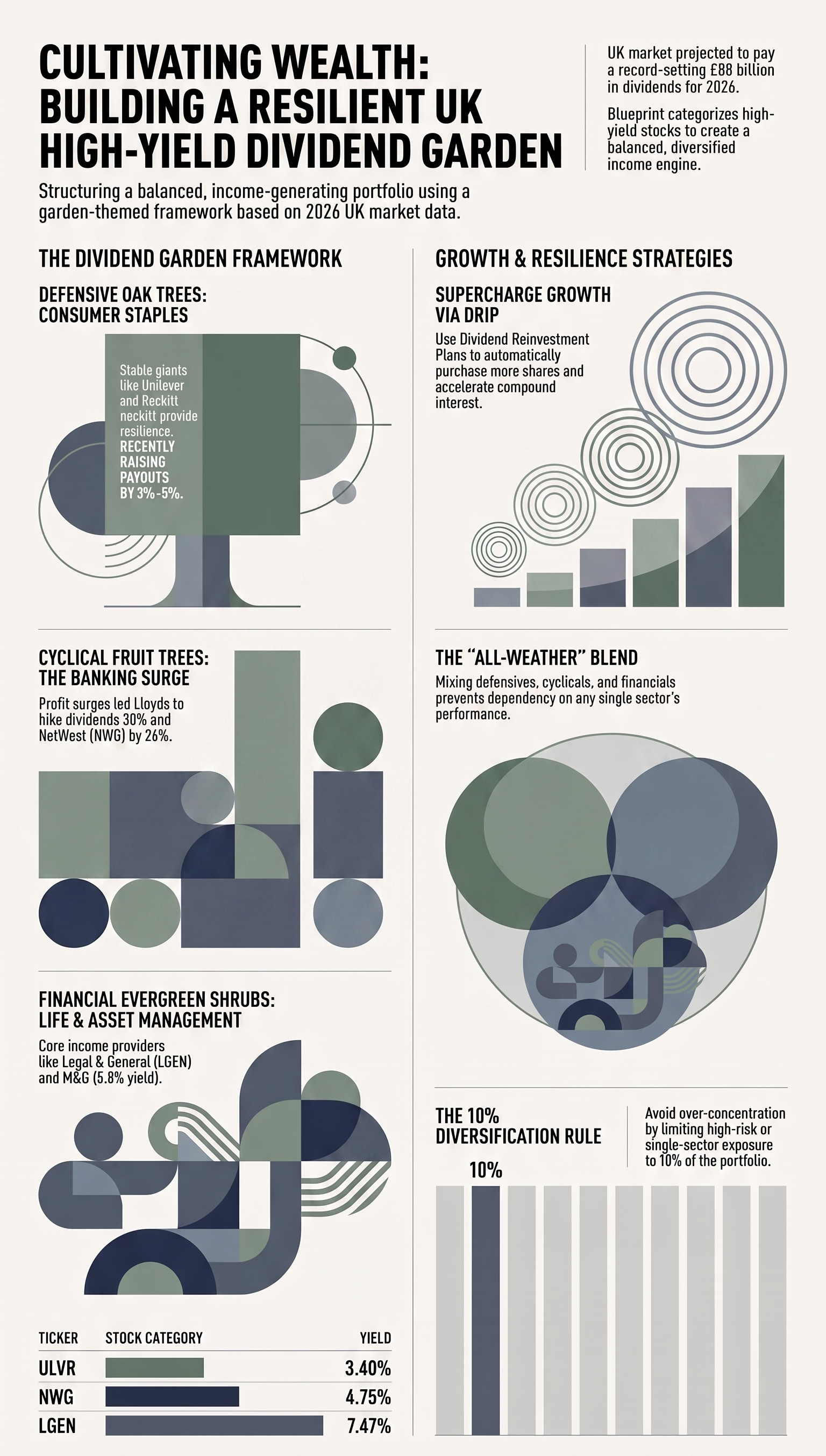
What Are The Common Blunders To Avoid When Investing In High Yield Dividend Stocks?
Even the most successful investors make misjudgments, but by learning from those who have walked the path before you, you can easily avoid the most painful pitfalls. Here are the two most common blunders beginners make when entering the world of high yield dividend stocks, and how you can avoid them.Blunder 1: Chasing Yield Blindly
We've touched on this, but it bears repeating because it is the number-one reason investors blow their money in the Stock Market. It is incredibly tempting to log into an investment platform, sort the stocks by "highest yield first," and simply buy the top three. But remember... an ultra-high yield is often a flashing red warning light, not an invitation. If a company's business is declining, its high historical yield is a mirage. Always check the dividend payout ratio and the company's recent earnings reports. If the profits are falling and the payout ratio is stretching past 90%, walk away. It is far better to buy a high-quality company yielding a safe, growing 5% than a faltering business yielding an unstable 10% that is on the verge of a dividend cut.Blunder 2: Ignoring Company Fundamentals And Competitive Advantages
A dividend is only as strong as the business that pays it. When you buy high yield dividend stocks, you must look at the actual business behind the ticker symbol. Does this company have a durable competitive advantage? In the investing world, we call this a "moat". Just like a medieval castle, a business with a wide economic moat is highly protected from competitors trying to poach its customers. A moat can take many forms...- A Powerful Brand: Think of Unilever, which owns household names like Dove and Ben & Jerry's. Supermarkets cannot easily afford to stop stocking their products because customers demand them.
- High Barriers to Entry: Think of massive insurers like Legal & General or Aviva, which require enormous regulatory approvals, capital reserves, and decades of trust to operate. A new start-up cannot simply appear overnight and lure away their multi-million customer base.
- Scale and Cost Advantages: Large-scale businesses can produce goods and services much cheaper than anyone else, protecting their profit margins.
Step-By-step: How To Start Your Dividend Investing Journey Today With High Yield Dividend Stocks
Taking the first step into Stock Market investing can feel intimidating, but it is actually incredibly simple and highly rewarding. You do not need thousands of pounds to begin; you can start with as little as £25 or £50. Here is your practical, step-by-step guide to buying your very first high yield dividend stocks today:1. Choose A Reputable UK Stockbroker Platform
Look for an investment platform that offers low fees, a user-friendly app, and supports a Stocks and Shares ISA (Individual Savings Account). An ISA is a wonderful UK tax wrapper that allows you to receive all your capital growth and passive income completely free from UK tax.2. Fund Your Account
Transfer a comfortable amount of cash into your broker account. Remember, you do not need a fortune. The goal is consistency... getting into the habit of investing a small portion of your salary every single month.3. Research And Select Your First Dividend Champion
Use the health checks we discussed. Look for a stable, blue-chip company with a solid business moat, a comfortable dividend payout ratio (under 60%), and a beautiful history of stable or growing payouts such as Legal & General (7.47% to 7.6% yield) or Aviva (5.38% to 5.8% yield).4. Place Your Order
Search for the company's ticker symbol on your platform (for example, LGEN for Legal & General, or AV. For Aviva). Select the "Buy" option, enter the amount you wish to invest, and confirm the transaction. Congratulations you are now an official Stock Market investor and a business owner!5. Turn On The Dividend Reinvestment Plan (DRIP)
Go to your account settings and select the option to automatically reinvest your dividends. This ensures that every penny of cash you receive is immediately put back to work buying more shares, supercharging your compound interest engine.6. Keep Adding And Keep Compounding
Make investing a proactive habit. Try to add a little bit of money to your portfolio every month. Watch as your share counts grow, your dividend cash flow expands, and your future financial freedom draws closer day by day. The path of income investing is a journey of patience, optimism, and discipline. You are not trying to get rich quick overnight... you are systematically building a highly resilient, cash-generating asset that will support you for the rest of your life. Start planting your wealth garden today, nurture it with regular contributions, and look forward to the day you can fully relax under the shade of your fully-grown wealth trees.Frequently Asked Questions About High Yield Dividend Stocks
What are high yield dividend stocks?
High yield dividend stocks are shares in established, financially sound companies that distribute a generous portion of their corporate net profits directly back to shareholders in the form of regular cash payments. They are the cornerstones of income investing, enabling everyday savers to generate a steady stream of passive income through Stock Market investing without selling their shares.
How can you avoid buying a "yield trap"?
You can avoid a yield trap by refusing to chase exceptionally high yields blindly. A yield trap occurs when a company's share price plummets due to unsound financial fundamentals, which mathematically inflates its trailing dividend yield. Protect yourself by looking at the company's dividend payout ratio (ensure it is under 60%), checking their dividend cover (ideally above 1.5x), and verifying that their cash flows and earnings are actually growing.
What is a healthy dividend payout ratio?
For most high yield dividend stocks, a dividend payout ratio between 50% and 60% is considered healthy and sustainable. It indicates that the company is returning a generous amount of cash to its owners while still retaining a comfortable portion of its profits to pay off debt, reinvest in operations, and protect the dividend in the event of an economic downturn.
How does a Dividend Reinvestment Plan (DRIP) help you grow wealth?
A Dividend Reinvestment Plan (DRIP) automatically uses your cash dividend distributions to purchase more shares of the same company, usually without broker fees. This allows you to steadily build up your total share count over time without adding new capital, allowing compound interest to work its magic and exponentially accelerate your long-term capital growth and passive income stream.
Why is the UK FTSE 100 popular for high yield dividend stocks?
The UK FTSE 100 is highly regarded globally because it features mature, cash-rich, internationally diversified businesses with a strong historical culture of returning capital to owners. Sectors like life insurance (such as Legal & General with a 7.47% to 7.6% yield) and financial services (such as M&G) consistently provide some of the most strong dividend streams in the financial world.
What is the difference between dividend yield and capital growth?
Dividend yield is the cash income paid directly to you as a percentage of your initial investment (like harvesting fruit from your trees). Capital growth is the increase in the market value of the shares themselves over time (like the value of your orchard land increasing). High yield dividend stocks are unique because they allow you to benefit from both: you get regular passive income cash flow alongside long-term capital growth.
Can a company cut or cancel its dividend payments?
Yes, dividends are never guaranteed. A company's board of directors can choose to reduce, suspend, or cancel dividend payments at any time if the business encounters severe financial issues, declining profits, or needs to preserve cash. This is why it is vital to invest in businesses with high dividend cover ratios, strong CADIs, and growing operating profits.
What does CADI mean in dividend growth investing?
CADI stands for Consecutive Annual Dividend Increases. It is a metric that tracks the exact number of years a company has raised its dividend consistently. Businesses with high CADI scores, like M&G with 7 years or Aviva with 6 years, demonstrate highly stable, reliable earnings and a strong corporate alignment with income investors.
Is dividend investing suitable for Stock Market beginners?
Absolutely. Dividend investing is highly suited for beginners because it focuses on stable, large-cap blue-chip companies with simple, understandable business models. It also provides a clear, motivating reward system: you get real cash deposited into your account, which provides a positive psychological feedback loop that encourages you to stay invested and keep saving.
How do I start investing in high yield dividend stocks today?
To start your journey, choose a low-cost UK brokerage platform, open a tax-free Stocks and Shares ISA, transfer your starting funds, and invest in a highly diversified basket of mature dividend-paying companies. Once you make your purchase, turn on the automated DRIP feature to start compounding your wealth immediately.
| 💡 Key Takeaways |
|---|
| High yield dividend stocks are wealth builders. These shares allow you to acquire ownership in strong, cash-rich firms that distribute consistent cash returns directly to you. |
| Passive income flow is the ultimate goal. Focusing on regular dividends lets you secure realised, real-world cash flow without needing to sell your underlying shares. |
| Always inspect the dividend yield carefully. Blue-chip UK firms like Legal & General provide exceptionally strong, reliable starting yields of around 7.47% to 7.6%. |
| Avoid dangerous yield traps. A mathematically high yield caused by a crashing share price is often a sign of business distress rather than sustainable value. |
| Use the dividend payout ratio as your shield. Ensure the company's payout ratio is sustainable (ideally under 60%) so they have a margin of safety. |
| Compound interest is your primary accelerator. Reinvesting your distributions through a dividend reinvestment plan (DRIP) exponentially expands your wealth over time. |
| Prioritise dividend growth investing. Focus on companies with a strong history of Consecutive Annual Dividend Increases (CADI), such as M&G (7 years) or Aviva (6 years). |
| Broadly diversify your Stock Market investing portfolio. Spread your capital across different sectors, blending defensive stalwarts with cyclical growers. |
| Seek businesses with a wide economic moat. Invest only in companies with durable advantages like brand scale or regulatory barriers that protect future profits. |
| Start small but remain consistent. You can open a tax-free Stocks and Shares ISA today with small monthly deposits and compound your way to lifelong freedom. |