The Ultimate Guide To The
Highest Paying Dividend Stocks:
How To Build Lasting Passive Income
In The UK Stock Market
If you have ever dreamt of making money from the Stock Market while you sleep, dividend investing is easily one of the most accessible and proven paths to getting there.
Imagine owning a portfolio of world-class businesses that deposit real, hard cash directly into your bank account every three months, without you needing to lift a finger, manage tenants, fix leaky taps, or sell off your valuable investment shares. That is the exact power and promise of investing in the highest paying dividend stocks.When I first started my investment journey, I was completely overwhelmed by financial news channels, complex trading jargon, and day-trading gurus promising quick riches through chart patterns.
It all felt like high-stakes speculation in a market where the broker always wins. Everything changed for me when I discovered Stock Market income through corporate cash dividends. Instead of guessing which way the Stock Market wind would blow tomorrow, I shifted my focus entirely to buying stakes in resilient, highly profitable businesses that regularly share their cash earnings with everyday investors. I want to walk you through everything I have learnt over the years about finding, evaluating, and profiting from the highest paying dividend stocks in a simple, straightforward, and practical way.Before we dive into the deep end, let's answer the main question straight away...
...The highest paying dividend stocks are shares of established, publicly traded companies that pay out a substantial percentage of their net profits back to shareholders as regular cash distributions, offering a dividend yield significantly above the overall Stock Market average. When selected carefully with strong cash flows and safe payout ratios, these stocks provide investors with a reliable stream of passive income alongside long-term capital growth potential.
What Are The Highest Paying Dividend Stocks And How Do They Work?
To truly demystify the highest paying dividend stocks, it helps to start with a simple real-world analogy that I love to share with new investors... The Apple Tree and the Orchard.
When you buy a share in a company, you become a partial owner of that business. Think of the company as a fruit-bearing apple tree in your orchard.
As the company grows its business, opens new locations, increases its revenues, and becomes more valuable over time, the tree grows taller, thicker, and stronger. This growth in the underlying value of the company represents your capital appreciation or capital gains. However, a healthy apple tree also produces fresh, ripe apples every single season. Instead of cutting down branches or selling off the whole tree to get cash, you simply harvest the apples that drop off the branches. Those apples represent your cash dividends.A dividend is simply a cash distribution that a company's board of directors decides to pay out to its shareholders from its after-tax profits.
While young, unprofitable tech startups prefer to keep every single penny of their cash to fund rapid growth and expansion, mature and highly profitable businesses generate far more cash than they actually need to run their daily operations. Rather than letting that cash sit idle in a corporate bank account, these cash-generative businesses return a portion of that money directly to you, the shareholder.When market analysts and investors talk about the highest paying dividend stocks, they are usually referring to businesses that offer a high headline dividend yield.
The dividend yield is expressed as an annual percentage and tells you how much cash income you will receive each year relative to the current share price of the stock. Calculating it is surprisingly simple:Let's walk through a practical real-world example to make this crystal clear.
Suppose you decide to purchase shares in a well-known UK financial services company trading at £10 per share on the London Stock Exchange.
If that company pays a total annual cash dividend of 80 pence (£0.80) per share to its investors, your annual dividend yield is calculated as:
If you invest £10,000 into that business, you can expect to collect £800 in passive income cash every single year, provided the company maintains its dividend payout.
To collect these cash payouts smoothly into your account, there are four key operational dates on the financial calendar that you need to understand:
- The Declaration Date: The official date when the company's board of directors announces the upcoming dividend payment, including the exact cash amount per share, the cutoff date, and the payout date.
- The Ex-Dividend Date: The single most critical cutoff date for buyers. You must own the stock before this specific trading day to be entitled to the upcoming dividend payout. If you buy the stock on or after the ex-dividend date, the previous owner receives the cash payment instead.
- The Record Date: Usually one business day after the ex-dividend date, when the company updates its official register of shareholders to confirm who holds the shares.
- The Payment Date: The glorious day when the cash dividend lands directly into your brokerage account or bank account!
In addition to standard quarterly or bi-annual ordinary dividends, some cash-flush companies occasionally award shareholders a special dividend.
A special dividend is an extra, one-off cash payment distributed after an exceptionally profitable year, a major asset sale, or a windfall gain, offering you a welcome bonus on top of your regular income stream.Why Are UK Investors Drawn To The Highest Paying Dividend Stocks?
If you live in the UK or invest in London-listed shares, you are positioned in one of the most income-friendly Stock Markets in the entire world.
The UK Stock Market, dominated by the prestigious FTSE 100 index, possesses a long-standing corporate culture focused on returning excess cash directly to shareholders. While US Stock Markets are heavily weighted toward mega-cap technology companies that pay low or zero dividends, the UK market is packed with mature, cash-rich blue-chip giants in financial services, insurance, consumer goods, energy, and commodities.To put this into perspective, companies listed on the FTSE 100 are forecast to distribute a record-breaking £88 billion in cash dividends to investors in 2026 alone!
While the overall average FTSE 100 dividend yield hovers around 3.5% to 4%, the top tier of the highest paying dividend stocks in the UK market frequently offer yields ranging between 6% and 8%.Here is why building a dedicated Stock Market income portfolio is so compelling compared to traditional UK wealth-building alternatives:
1. Beats Low Bank Savings Rates
While interest rates on traditional bank savings accounts rise and fall with central bank policy and rarely outpace inflation over long periods, high-yielding dividend stocks offer the potential for generous cash yields combined with long-term share price growth.2. Replaces the Uncertainty of Buy-to-Let Property
For generations, UK investors relied on buy-to-let residential property as their primary source of passive income. However, with rising mortgage rates, heavy stamp duty surcharges, stricter environmental regulations, and the constant threat of non-paying tenants or costly repairs (like replacing a broken central heating boiler), property is no longer frictionless. Dividend investing provides true passive income from stocks with no tenant calls, no maintenance overheads, zero property taxes, and total liquidity to sell shares at a click of a button.3. Built-in Protection Against Inflation
Inflation erodes the purchasing power of fixed cash savings over time. However, high-quality, market-leading companies possess pricing power - the ability to raise product prices in line with inflation. As their sales revenues and profits rise alongside inflation, they can increase their cash dividend payouts, protecting your standard of living.4. Completely Tax-Free Income With A UK ISA
One of the greatest advantages for UK investors is the ability to hold dividend stocks inside a Stocks and Shares ISA. You can invest up to your annual £20,000 ISA allowance every tax year, and every single penny of dividend income and capital gains you generate remains 100% tax-free for life! Outside an ISA, the UK dividend allowance has been reduced to just £500, making tax-sheltered investing more essential than ever before.What Are The Current Highest Paying Dividend Stocks In The UK Market?
When searching for the highest paying dividend stocks, it is vital to look under the hood of real companies across different economic sectors.
In the London market, high-yielding dividend opportunities are heavily concentrated in mature, cash-generative industries. Let's examine the major UK high-yield sectors, how they operate, and real-world company examples that income investors actively track.1. Life Insurance, Wealth, And Asset Management
The UK financial services sector is home to some of the absolute highest-yielding dividend stocks in Europe.
Industry leaders such as Legal & General (L&G), Aviva, Phoenix Group, and M&G consistently boast dividend yields ranging from 6.5% to an astonishing 8%.Why are these financial institutions able to maintain such generous payouts year after year? The answer lies in their sticky, recurring fee models.
Every month, millions of UK workers automatically transfer money from their monthly paycheques into workplace pension schemes, annuity funds, life insurance policies, and ISA investments managed by these firms. These companies earn steady management fees on hundreds of billions of pounds in customer assets under management. Also, financial institutions operate under strict capital framework rules (such as Solvency II), keeping large solvency surplus capital buffers that ensure they can fund generous dividends while maintaining high financial strength.2. Consumer Staples And Household Brand Leaders
Consumer staples are everyday essential items that households buy regardless of whether the economy is booming or in a deep downturn - products like personal care, cleaning supplies, food, and beverages.
Within this defensive sector sit London-listed FTSE 100 powerhouses like Unilever, Reckitt Benckiser, and supermarket titan Tesco.These consumer staples companies feature prominently among the highest paying dividend stocks for defensive investors on the London Stock Exchange, typically offering steady yields between 3.5% and 5.5% alongside a strong track record of progressive dividend growth.
Because households buy soap, cleaning products, packaged food, and groceries regardless of economic conditions, these companies generate highly predictable, economic-resistant cash flows. Exceptional brand equity and pricing power allow them to pass cost inflation through to consumers, protect profit margins, and comfortably sustain cash distributions to shareholders year after year.3. Global Resources, Mining And Oil Majors
Mining multi-nationals like Rio Tinto and Glencore, alongside oil and gas giants Shell and BP, represent major engines of dividend distribution in the FTSE 100.
When global demand for commodities like iron ore, copper, oil, and natural gas is strong, these companies generate vast cash profits, delivering high ordinary yields often complemented by generous special dividends, taking total yields into the 7% to 9% territory. However, resource stocks operate in highly cyclical markets. When commodity prices drop during a global economic slowdown, corporate cash earnings contract. To manage this volatility responsibly, many mining and energy giants operate variable dividend policies, meaning their cash payouts naturally expand during boom times and adjust downward during downturns.4. Real Estate Investment Trusts (REITs)
UK Real Estate Investment Trusts (REITs) are specialised property investment companies that own, operate, and manage income-generating commercial real estate, such as shopping centres, logistics warehouses, healthcare facilities, and office buildings.
Popular examples include Land Securities, British Land, and Supermarket Income REIT.By UK tax law, REITs enjoy tax exemptions on their rental profits on one strict condition... they must distribute at least 90% of their tax-exempt rental income directly to shareholders as cash dividends (known as Property Income Distributions, or PIDs).
This statutory mandate makes REITs an attractive vehicle for investors looking for property-backed high dividend yields in the 6% to 8.5% range.5. Telecommunications And Utilities
Telecommunications operators like Vodafone have historically offered high headline yields (frequently exceeding 8%) thanks to steady, recurring subscriber payments from mobile contracts and fiber broadband connections.
Similarly, regulated water and electricity utilities like National Grid provide steady defensive yields around 5% to 6%. However, telecommunications and utility firms carry heavy debt loads to fund network infrastructure upgrades, requiring investors to carefully scrutinise their balance sheets and borrowing costs.High Yield vs Dividend Growth: Which Highest Paying Dividend Stocks Should You Choose?
One of the most critical strategic choices you will face as an income investor is deciding whether to focus on immediate high yield or long-term dividend growth.
Understanding the trade-offs between these two philosophies is essential for constructing a portfolio tailored to your personal financial goals.To illustrate how these two approaches play out over time, let's compare two distinct investment strategies side by side:
Strategy 1: The High-Yield Focus (An 8% Static Yield)
Suppose you invest £10,000 into a portfolio of mature, high-yielding stocks offering an average dividend yield of 8% today, but with slow annual dividend growth of 1% to 2%. In year one, you will collect a magnificent £800 in cash dividend payments. This strategy is ideal for retirees or investors who need maximum cash income right now to cover daily living expenses without waiting years for income to grow.Strategy 2: The Dividend Growth Focus (A 3.5% Yield Growing At 9% Annually)
Now consider investing £10,000 into high-quality dividend growth stocks or recognized dividend aristocrats - such as global consumer leader Unilever or publishing powerhouse RELX. These growth-focused companies might offer a lower initial dividend yield of 3.5%, delivering £350 in year one. However, because these businesses are expanding their market share, revenues, and profits, they systematically raise their cash dividend payouts by 9% every single year.Let's look at how the annual cash income from these two £10,000 investments compares over a 15-year holding period:
| Strategy Metric | Fund A: The High-Yield Trap | Fund B: The Quality Dividend Growth Fund |
|---|---|---|
| Year 1 | £800 | £350 |
| Year 5 | £832 | £494 |
| Year 10 | £866 | £760 |
| Year 15 | £901 | £1,170 |
By year 15, the annual cash payout from the dividend growth portfolio (£1,170) has blown past the flat payout of the high-yield portfolio (£901)!
Also, because the dividend growth companies expanded their underlying business profits over those 15 years, their share prices will have appreciated significantly, delivering substantial capital gains on top of your income stream.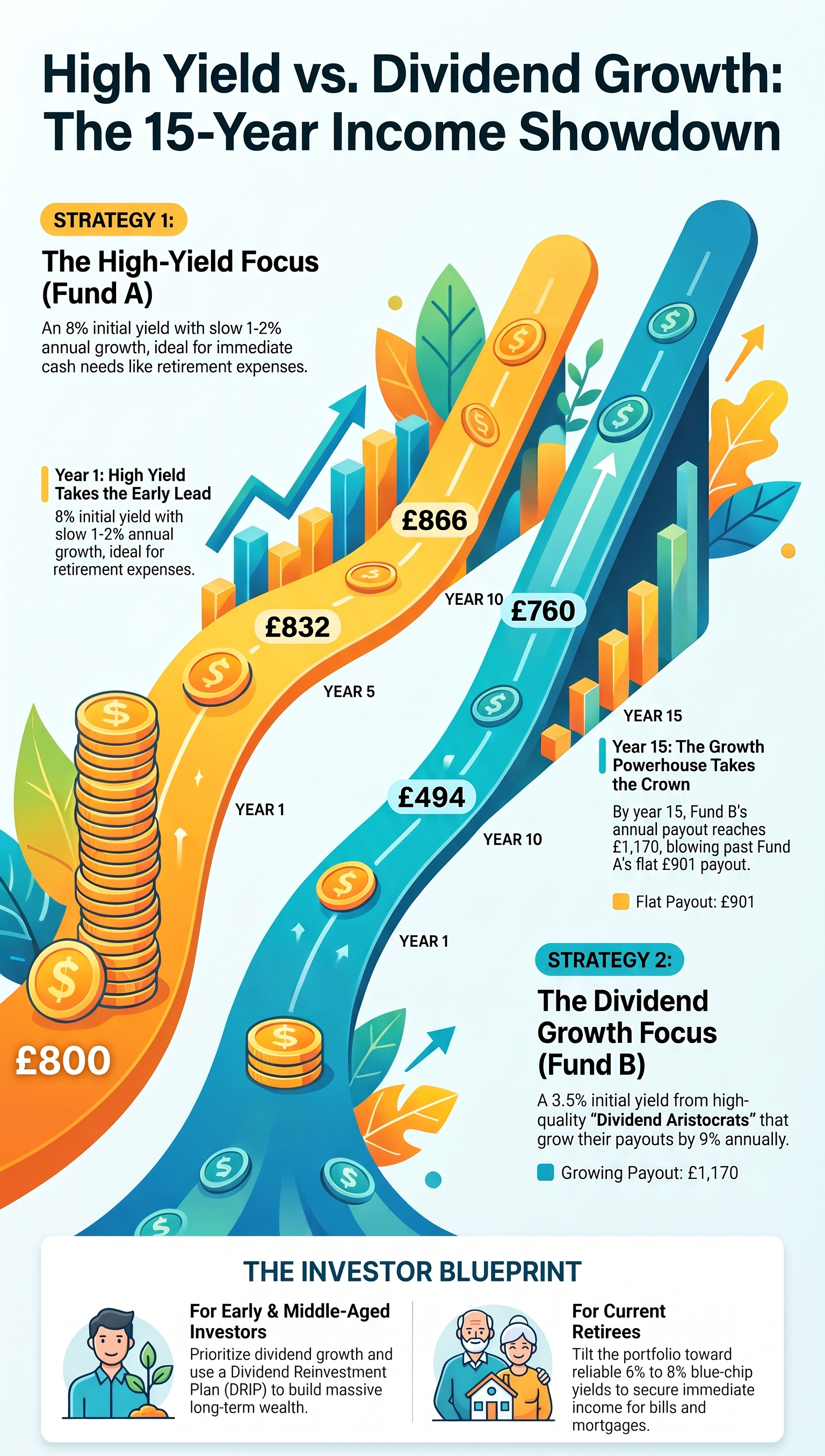
The Investor Blueprint
If you are early in your investing career or middle-aged, prioritizing dividend growth and reinvesting your cash payouts through a dividend reinvestment plan (DRIP) will build massive wealth over time. If you are already retired and require cash to pay your immediate household bills today, tilting your portfolio toward reliable, high-yielding blue chips paying 6% to 8% offers immediate income security.How Can You Spot A Dividend Yield Trap In The Highest Paying Dividend Stocks?
Here is a vital truth that every seasoned dividend investor learns... a sky-high dividend yield is a starting point for deeper research, never a guarantee of financial safety!
In the Stock Market, blindly chasing the absolute highest paying dividend stocks without examining business fundamentals is the fastest way to walk directly into a perilous financial pitfall known as a dividend yield trap.
What is a dividend yield trap?
Consider this real-world analogy. Imagine walking past a car showroom and seeing a flashy luxury sports car priced at just £1,000. It looks like an incredible bargain on the surface! But when you open the bonnet, you discover that the engine is cracked, the chassis is rusted through, and the car requires £15,000 in repairs just to start. The low price was not a bargain; it was a desperate attempt to sell a broken machine.The exact same mathematical principle applies to dividend stocks. Remember the dividend yield formula:
For instance, if a company trading at £20 pays an annual dividend of £1, its initial yield is 5%.
If adverse financial news causes the share price to fall from £20 down to £5 while the company has not yet officially announced a dividend cut, the stock screener will mechanically display an enticing dividend yield of 20% (£1 / £5)! Unwary investors rush in thinking they have found a secret 20% cash cow, only for the company's board of directors to announce weeks later that they are cutting or completely eliminating the dividend to preserve cash. The share price drops even further, leaving investors with both a cut in cash income and a devastating loss of capital.To protect your capital and income when evaluating the highest paying dividend stocks, always check for these four major warning signals:
- Unsafe Payout Ratio (More than 85%): If a company distributes almost all of its net earnings as dividends, it leaves zero financial buffer to absorb unexpected economic slowdowns or rising costs.
- Unsafe Dividend Cover (Less than 1.5x): Dividend cover measures how many times net earnings cover the dividend payout. A ratio below 1.5x indicates razor-thin safety, while a ratio below 1.0x means the company is paying dividends out of debt or cash reserves.
- Crippling Corporate Debt: When a business carries heavy debts during periods of high interest rates, bank loan repayments take legal priority over dividend distributions to shareholders.
- Deteriorating Free Cash Flow: If net cash generated from core business operations is consistently lower than the total cost of dividend payments, a dividend cut is almost inevitable.
How Do You Analyse The Highest Paying Dividend Stocks Using Key Metrics?
When I analyse potential additions for my dividend portfolio, I do not rely on media hype or gut feelings. Instead, I put every candidate stock through four simple, quantitative financial health checks.
You can easily find these metrics on free Stock Market platforms or your broker's analysis tools.Metric 1: The Dividend Payout Ratio
The dividend payout ratio calculates what percentage of net after-tax earnings a company distributes to its shareholders as dividends:
Here is a simple benchmark guide for standard commercial companies:
- Below 60%: Exceptionally safe payout with vast room for future dividend expansion.
- 60% to 70%: Healthy, sustainable payout ratio standard among mature blue-chip income stocks.
- 70% to 85%: Acceptable for steady, cash-flow rich sectors like utilities or REITs, but requires monitoring for cyclical firms.
- Above 90%: High-risk zone! The company has almost no margin for error if earnings dip.
Metric 2: Dividend Cover Ratio
Dividend cover is simply the inverse of the payout ratio and measures how many times over earnings per share (EPS) can pay the dividend per share (DPS):
An ideal dividend cover ratio is 1.5x to 2.0x or higher.
A cover ratio of 2.0x means the company earned twice as much money as it paid out in dividends, providing a massive 50% safety cushion if company profits take a temporary hit during a downturn.Metric 3: Free Cash Flow Dividend Coverage
While accounting net profit is useful, experienced investors know that accounting earnings can be influenced by non-cash adjustments, depreciation rules, and inventory valuation.
Cash, however, is absolute reality! Dividends are paid out of actual cash in the bank, not paper accounting profits.Always inspect the company's Free Cash Flow (FCF) - the actual cash remaining after paying all cash operating expenses and necessary capital investments.
Subtract total annual dividend costs from Free Cash Flow. If FCF comfortably covers the dividend payment year after year, you can sleep soundly knowing your dividend income is secure.Metric 4: The 5-To-10-Year Dividend Track Record
While past performance is not a guarantee of future outcomes, a company's historic dividend payment track record reveals management's attitude toward shareholders.
Look for resilient companies that maintained or increased their dividend distributions through major economic crises, such as the 2008 financial downturn and recent inflationary spikes. A five to a decade-long track record of uninterrupted dividend payouts demonstrates a strong corporate commitment to returning cash to owners.How Can You Build A Passive Income Strategy With The Highest Paying Dividend Stocks?
Now that you possess the analytical tools to evaluate high-yielding stocks safely, let's translate theory into an actionable, step-by-step portfolio blueprint that you can implement today.
Step 1: Set Up A Tax-Sheltered Stocks And Shares ISA
Before purchasing your first share, ensure your investment account is structured for maximum tax efficiency. For UK residents, opening a Stocks and Shares ISA is the single best decision you can make.
You can invest up to £20,000 each tax year, and every single penny of dividend income and capital gains you earn inside the account is 100% tax-free for the rest of your life.Step 2: Diversify Across Multiple Non-Correlated Sectors
Never put all your financial eggs in one basket! Even the most seemingly indestructible company can face unexpected regulatory changes, management blunders, or industry disruption.
A strong dividend portfolio should spread capital across at least 20 to 30 high-quality companies operating in different economic sectors:- Financials & Life Insurance: For high current yield (e.g. Legal & General, Aviva).
- Consumer Staples & Household Brand Leaders: For recession-proof earnings stability (e.g. Unilever, Tesco).
- Essential Utilities & Infrastructure: For stable, inflation-linked cash flows (e.g. National Grid, Severn Trent).
- Global Mining & Energy: For inflation protection and natural resource exposure (e.g. Rio Tinto, Shell).
- Real Estate Investment Trusts: For property-backed rental income streams (e.g. Supermarket Income REIT).
Step 3: Enable Automatic Dividend Reinvestment (DRIP)
If you do not require your dividend payouts immediately to pay for living expenses, activate a Dividend Reinvestment Plan (DRIP) through your investment platform.
A DRIP automatically takes every cash dividend payment you receive and reinvests it to buy additional shares or fractional shares in the same company, usually with low or zero trading fees.This triggers a powerful compounding engine of wealth generation:
- Your stock portfolio pays you cash dividends.
- Your DRIP automatically buys more dividend-paying shares with that cash.
- Next quarter, your larger share count produces even bigger cash dividend payouts!
- Repeat this compounding cycle over 10 to 20 years, and your passive income stream will grow exponentially.
Step 4: Conduct Periodic Portfolio Reviews
Dividend investing is wonderfully hands-off, but it is not completely passive. Schedule a quarterly review after companies release their half-year and full-year earnings results.
Verify that dividend cover remains strong, check that free cash flow covers dividend payments, and ensure your sector balance remains aligned with your long-term income goals.Final Thoughts On Investing In The Highest Paying Dividend Stocks
Building long-term wealth through the highest paying dividend stocks is not about chasing short-term Stock Market hypes or getting rich overnight.
It is a proven, disciplined, and empowering strategy for establishing true financial independence through regular cash flow from world-class businesses.By focusing on company quality, verifying safe dividend cover ratios, steering clear of treacherous yield traps, and holding your investments inside a tax-free Stocks and Shares ISA, you can transform the Stock Market into your personal passive income engine.
Start small, stay consistent, reinvest your dividends, and enjoy watching your income stream grow year after year!Frequently Asked Questions About The Highest Paying Dividend Stocks
What are the highest paying dividend stocks?
The highest paying dividend stocks are shares of established, profitable companies that pay out a large percentage of their cash earnings back to shareholders, offering dividend yields well above the market average (often between 6% and 8%).
How do I start investing in the highest paying dividend stocks in the UK?
You can start by opening a tax-sheltered UK Stocks and Shares ISA with a reputable online broker, funding your account, and selecting a diversified mix of high-yielding, financially secure blue-chip stocks.
What is a good dividend yield for highest paying dividend stocks?
A healthy, sustainable dividend yield typically sits between 2% and 5%. While yields above 8% to 10% are attractive, they require careful scrutiny of dividend cover and cash flows to ensure they are not dividend yield traps.
What is the difference between dividend yield and dividend payout ratio?
Dividend yield measures annual cash payout relative to stock price (Income / Share Price), whereas dividend payout ratio measures the percentage of net profit paid out to shareholders (Dividends Paid / Net Income).
How can I avoid dividend yield traps when looking at highest paying dividend stocks?
Avoid yield traps by checking that the dividend payout ratio is below 60%, dividend cover is above 1.5x earnings, corporate debt levels are manageable, and free cash flow comfortably exceeds dividend payments.
Are dividends from highest paying dividend stocks taxed in the UK?
If you hold your stocks inside a UK Stocks and Shares ISA or SIPP pension, all dividend income is 100% tax-free. Outside an ISA, dividend income above the annual UK dividend allowance (£500) is taxed at your personal dividend tax rate.
What happens to my income if a company cuts its dividend payout?
If a company cuts its dividend, your cash income from that stock will decrease proportionally. This is why spreading your capital across 20 to 30 stocks in different sectors is essential to protect your total income stream.
How often do highest paying dividend stocks pay cash dividends?
Most UK-listed companies pay dividends twice a year (an interim dividend and a final dividend), though some UK blue chips and US stocks distribute cash payouts quarterly or even monthly.
Should I choose high-yield dividend stocks or dividend growth stocks?
Retirees needing immediate maximum income often prefer high-yield stocks (6% to 8%), whereas younger investors aiming to build wealth over 10 to 20 years benefit more from dividend growth stocks (2% to 5% initial yield growing 8% to 12% annually).
Can I automatically reinvest my dividends from highest paying dividend stocks?
Yes! Most UK investment platforms offer a Dividend Reinvestment Plan (DRIP) that automatically uses your cash dividend payouts to buy extra shares in the same company, compounding your wealth over time.
| 💡 Key Takeaways |
|---|
| Highest paying dividend stocks pay above-average cash distributions out of earnings, providing steady passive income from stocks. |
| The formula for dividend yield is (Annual Dividend Per Share / Share Price) x 100, showing your cash return relative to investment. |
| UK investors benefit from a rich dividend culture, with FTSE 100 dividend stocks projected to distribute £88 billion in 2026. |
| Holding income investments inside a UK Stocks and Shares ISA makes all dividend payouts and capital gains 100% tax-free for life. |
| Watch out for dividend yield traps where a falling share price artificially inflates the headline yield before a dividend cut. |
| Always check the dividend payout ratio (ideally below 60%) and dividend cover (ideally above 1.5x) for payout safety. |
| Verify that free cash flow comfortably covers cash dividend obligations, as accounting profits can hide cash shortfalls. |
| Balancing immediate high-yield blue chips with dividend growth stocks (or dividend aristocrats) creates sustainable income expansion. |
| Enabling a dividend reinvestment plan (DRIP) automatically compounds your cash returns by buying additional shares over time. |
| Diversifying capital across 20 to 30 companies in non-correlated sectors protects your total cash flow against individual company cuts. |