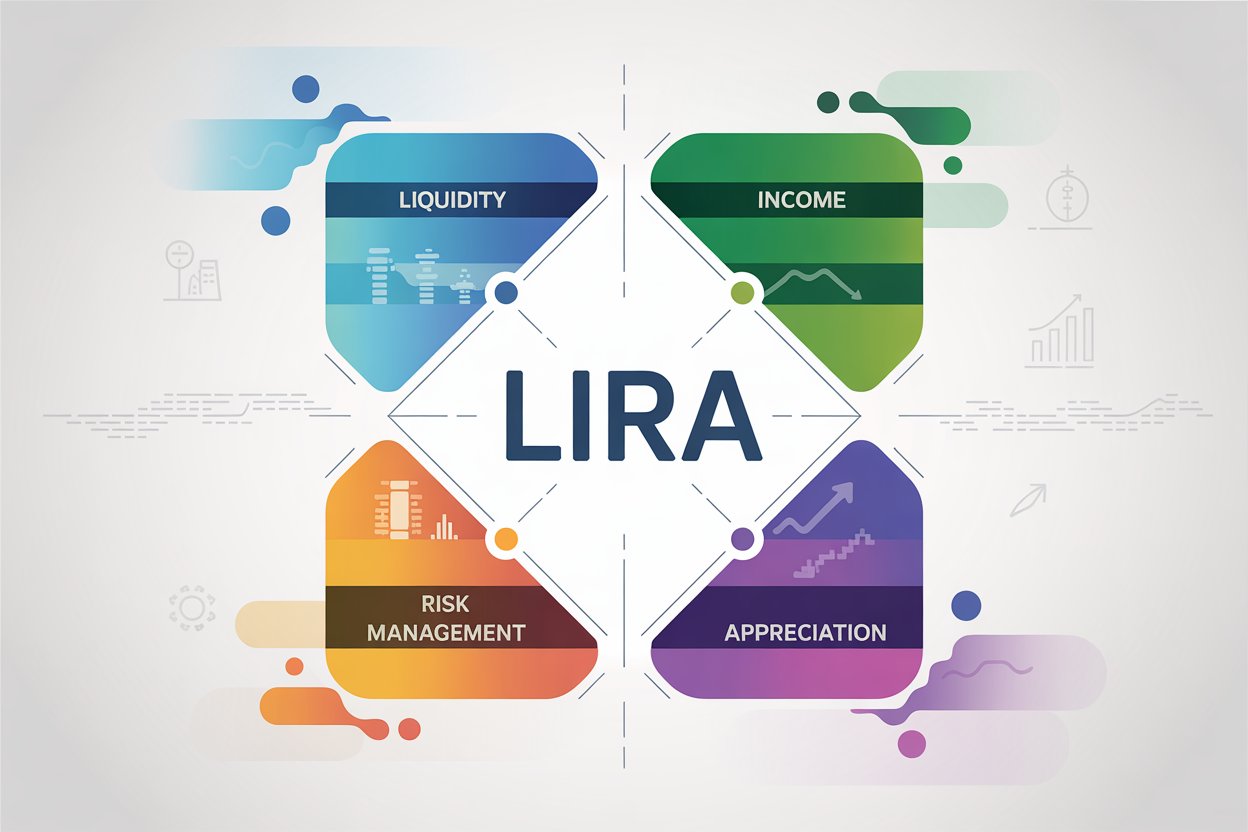
LIRA Investment Framework:
A Comprehensive Approach To
Investing Success And Wealth Building
L - Liquidity: Your Financial Safety Net
Liquidity is your first line of defence. It refers to money you can get to quickly and without losing value. Having enough liquid cash stops you from having to sell investments at unfavourable times, perhaps when markets have fallen and you would lock in a deficit.
Why Liquidity Comes First
Before you even think about buying dividend paying shares, you need a buffer. Life is full of surprises... the boiler breaks, the car needs a big repair, or your income drops for a while.
If you have no ready cash, you might be forced to borrow at high interest rates or cash in long-term investments you had hoped to leave untouched.A sensible starting point is an emergency fund that covers three to six months of your typical outgoings. If your job is very secure, you could lean towards three months.
If your income varies or you are self-employed, aim for six months to a year. This money is not for investing... it is your insurance against life's curveballs.Where To Keep Your Cash
Several safe and easy-access options exist:
- Easy-access savings accounts from banks or building societies. These let you withdraw money whenever you need it.
- Cash ISAs (Individual Savings Accounts). The interest you earn is tax-free, and you can put up to £20,000 each tax year into ISAs overall. A cash ISA is a good home for part of your emergency fund.
Avoid locking up all your spare cash in fixed-term accounts that penalise early access. The whole point of liquidity is getting your hands on the money fast, without fees or waiting periods.
Beyond The Emergency Fund
Liquidity also means having some money ready for opportunities. If share prices suddenly drop and you see a high-quality investment at a bargain price, having cash gives you the power to act.
Without it, you can only watch. Keeping a small amount of "opportunity cash" in an easy-access account is a wise habit.Key Investment Rule: Never put money you might need within the next five years into the Stock Market. Short-term savings belong in cash or cashlike investments. The "L" in LIRA reminds you to keep that foundation solid.
I - Income: Building Cash Flow From Your Investments
The second part of the framework is Income. This is about creating a steady stream of cash from your investments, money that lands in your account without you having to sell anything.
Income gives you more freedom, reduce your reliance on a salary, and help you sleep better during rocky markets.Why Income Matters
When your investments pay you regular cash, you gain options. You can spend it to cover living costs, use it to top up your pension income, or reinvest it to buy more shares.
Reinvesting income is especially powerful because it lets you benefit from pound-cost averaging, buying more when prices are low and fewer when they are high, all automatically.Income also smooths out the ride. Even if share prices fall, the dividends or interest payments often continue.
Seeing income arrive in your account can make market dips feel less scary, encouraging you to stay invested rather than panic-sell.Sources of Income
There are several realistic ways to generate income, each with different levels of risk and reward.
Dividend-Paying Shares
Many large UK companies pay dividends, which are a share of their profits sent to shareholders. The FTSE 100 index is full of well-known names that have long histories of paying dividends. When you own individual shares, you receive dividends directly.
Dividend ETFs And Funds
If picking individual shares feels too scary or time-consuming, you can buy an Exchange-Traded Fund (ETF) or a fund that holds a basket of dividend-paying companies. This spreads your money across many firms, lowering the impact if one cuts its payout.
Building Your Income Stream
Start by deciding what you want the income for. If you are still working, reinvesting everything makes sense.
If you are in semi-retirement, you might begin drawing the income. Over time, you can build multiple income sources so you are not relying on any single company or sector.Key Investment Rule: The "I" in LIRA reminds you that your portfolio can work for you by producing cash. Once you have that cash, you are in control.
R - Risk Management: Protecting What You Have
You cannot grow wealth if you lose it all early on. Risk management is the part of the framework that helps you stay in the game through good times and choppy times.
It is about understanding what could set you back and putting simple rules in place to limit permanent damage.Know Your Own Risk Tolerance
Risk tolerance is how much uncertainty you can handle without making unwise decisions. You can watch your portfolio drop 30% and see it as a buying opportunity.
We do not lose sleep but rather take it as an opportunity to buy more shares. Because of this we build our portfolios more conservatively.Diversification: Do Not Put All Your Eggs In One Basket
The most basic risk management tool is spreading your money around. That means owning different types of assets, not just a handful of shares. We diversify across:
- Asset Classes: Shares, ETFs, Cash.
- Sectors: Technology, Consumer Goods, Energy, Financials.
- Geographies: UK, US, Europe, Asia, Emerging Markets.
Position Sizing And Concentration
Avoid letting any single investment become too large a slice of your portfolio. A good guideline is never to have more than 5% of your total wealth in one company's shares.
That way, even if that business goes bust, the setback is painful but not disastrous. The same thinking applies to sectors. You do not want most of your money riding on technology or banking, no matter how confident you feel.Asset Allocation And Rebalancing
Your mix of shares should match your goals and timeline. In your 20s and 30s, you might have 80% or more in shares.
As you approach retirement, you might gradually shift towards a more consevative approach.Simple Rules Save You From Yourself
The biggest risk to your portfolio is often your own behaviour, acting on fear or greed. Risk management is about having a plan you can stick to when the headlines are frightening.
Key Investment Rule: The "R" in LIRA stands guard, making sure one lousy year does not undo a decade of good decisions.
A - Appreciation: Growing Your Wealth For The Long Term
The final piece of the framework is Appreciation, the engine that builds real wealth over time.
While income gives you cash today, "Appreciation" increases the value of your assets so that your future is more secure. This is where the magic of compounding happens.What Drives Appreciation
The simplest way to benefit from Appreciation is to own a slice of growing businesses.
Over decades, the global Stock Market has risen, reflecting innovation, population growth, and rising productivity. When you hold a diversified portfolio of shares, you are riding that long-term upward trend.Share price growth comes from two places: earnings growth and rising valuations. Reliable businesses that increase their profits year after year tend to see their share prices follow.
While short-term price movements are noisy and often random, the long-term direction is powered by real economic progress.Strategies For Long-Term Growth
Dividend Growth Shares
Some companies do not just pay dividends; they raise them every year. These "dividend growers" exhibit steady business models and pricing power.
By reinvesting those growing dividends, you accelerate your compound returns. Over time, the income from such shares can outstrip the cash flow from other investments many times over.Small-Cap And Mid-Cap Opportunities
Large companies can be safer, but smaller firms sometimes offer faster growth. A small allocation to smaller companies boost long-term returns.
Tax-Efficient Wrappers For Growth
- Stocks And Shares ISA: You can invest up to £20,000 each tax year, and all capital gains and dividends are taxfree.
- Self-Invested Personal Pension (SIPP): Contributions receive tax relief, and your investments grow free from capital gains tax and income tax. Withdrawals in retirement are taxed, but you have plenty of time to compound before then.
Using both wraps allows you to keep more of what your investments earn, supercharging the appreciation effect.
The Role of Patience
Appreciation is not a get-rich-quick scheme. Real wealth comes from staying invested for years, adding money regularly, and letting time do the heavy lifting.
In the Stock Market patient investors who stick with a sensible plan are rewarded.Key Investment Rule: The "A" in LIRA is your forward-looking vision. It keeps you focused on where you want to be in ten or twenty years, not on today's market noise.
Putting The LIRA Framework Into Action
Knowing each part of LIRA is one thing... weaving them together is where the real benefit lies. The framework is a set of priorities you adjust throughout your life.Balancing The Four Parts
Early Career (20s - 30s)
Your emergency fund (L) is essential but can be on the smaller side as you have fewer obligations. Income (I) can be fully reinvested. Risk management (R) means a high share allocation and wide diversification, because you have decades to recover from downturns. Appreciation (A) will be your biggest focus.
Mid-Career (40s - 50s)
Your earnings likely peak, so you can build liquidity and invest more. You might trim the share allocation slightly, from 80% to 70%. Income generation becomes more attractive as a second income stream.Nearing Retirement (Late 50s - 60s)
Liquidity becomes crucial, with one to two years of living expenses in cash. Income takes centre stage, as you start to rely on your portfolio for day-to-day spending. Risk management shifts toward protecting against a market downturn, with a higher cash buffer. Appreciation remains important because your retirement could last 30 years, so you still need growth to fight inflation.In Retirement
Draw a sensible income, keep the portfolio diversified, and maintain enough cash so you are never forced to sell. A withdrawal rate of 3% - 4% of your pot per year, adjusted for inflation is wise and a great strategy.Regular Review And Simple Habits
The LIRA Investment Framework works best when you revisit it at least once a year. Check your emergency fund level. See if your income stream is on track. Rebalance your portfolio back to your target allocation. Confirm that your growth assets are still aligned with your long-term goals.
A regular investing habit, monthly direct debits into your ISA or SIPP, automates these good behaviours. You can easily set up a plan where your contributions are split according to your current LIRA balance, building wealth without daily effort.
A Framework You Can Trust
Investing does not demand a degree in economics or the ability to predict the future. It asks for common sense, patience, and a framework you can trust. LIRA gives you that structure: Liquidity for today's security, Income for steady cash flow, Risk Management to stay safe, and Appreciation to build the future you want.
By following these four simple letters, you can navigate the ups and downs of the market with confidence.