Natwest Dividend Guide:
How To Compound Your Passive Income
 It sounds like a dream, doesn't it? But this is not a fantasy... it is the reality of being a shareholder and receiving the regular Natwest dividend payments that come with it.
When you buy a share of a company, you are not just purchasing a ticker symbol on a screen; you are buying a tiny piece of a real-world business including its physical buildings, its digital banking apps, and its future earnings streams.
For anyone looking to make money from the Stock Market, especially through the reliable path of dividend investing, UK high-street banks present a fascinating opportunity. Dividend investing is the art of buying shares in stable, profit-making businesses and letting them distribute a portion of those earnings back to you in cash.
It is the financial equivalent of planting a thriving apple orchard... you buy the trees once, and each season they drop fresh, ripe fruit into your lap without you having to lift a finger.
Among the FTSE 100 dividend stocks, Natwest Group PLC (trading under the ticker NWG) has emerged as an incredibly compelling option for investors seeking a blend of high income, corporate recovery, and resilient UK economic banking dominance.
Let's start by answering the core question you are probably asking right now...
Natwest's dividend is a regular cash payment made by Natwest Group PLC to its shareholders, representing their portion of the bank's earnings, and currently offers an attractive estimated dividend yield of 5.06%. For income investors, this payment provides a highly reliable stream of passive income that can be spent immediately or reinvested to accelerate long-term wealth compounding.
It sounds like a dream, doesn't it? But this is not a fantasy... it is the reality of being a shareholder and receiving the regular Natwest dividend payments that come with it.
When you buy a share of a company, you are not just purchasing a ticker symbol on a screen; you are buying a tiny piece of a real-world business including its physical buildings, its digital banking apps, and its future earnings streams.
For anyone looking to make money from the Stock Market, especially through the reliable path of dividend investing, UK high-street banks present a fascinating opportunity. Dividend investing is the art of buying shares in stable, profit-making businesses and letting them distribute a portion of those earnings back to you in cash.
It is the financial equivalent of planting a thriving apple orchard... you buy the trees once, and each season they drop fresh, ripe fruit into your lap without you having to lift a finger.
Among the FTSE 100 dividend stocks, Natwest Group PLC (trading under the ticker NWG) has emerged as an incredibly compelling option for investors seeking a blend of high income, corporate recovery, and resilient UK economic banking dominance.
Let's start by answering the core question you are probably asking right now...
Natwest's dividend is a regular cash payment made by Natwest Group PLC to its shareholders, representing their portion of the bank's earnings, and currently offers an attractive estimated dividend yield of 5.06%. For income investors, this payment provides a highly reliable stream of passive income that can be spent immediately or reinvested to accelerate long-term wealth compounding.
What Is Natwest's Dividend And How Does It Generate Passive Income?
To understand how Natwest's dividend can help you build your financial freedom, we first need to strip away the complex City jargon and look at what a dividend actually represents. Think of a major corporation like a massive, high-tech high-street bakery. Every day, this bakery sells thousands of loaves of bread, pastries, and custom cakes. After paying for flour, sugar, electricity, staff wages, insurance, and rent, the bakery is left with a healthy pile of surplus cash. Now, the bakery owner has a choice. They can use that surplus to buy more ovens to expand, or they can distribute that cash back to the people who funded the bakery in the first place... the shareholders. In the corporate world, Natwest Group PLC is that massive high-tech bakery, and instead of baking bread, it provides essential financial services. It lends money to homebuyers through mortgages, provides credit cards to consumers, and offers payment services to retail, commercial, and private banking clients across the United Kingdom. Every time a homeowner pays interest on their mortgage, a business pays a fee for its merchant account, or a corporate client uses asset management services, Natwest generates revenue. After covering all its operational costs, interest on savings deposits, and setting aside reserves for potential non-performing loans, the bank is left with a substantial pool of net income. For example, in the fiscal year of 2025, Natwest's financial performance was outstanding, generating a total revenue of £16.61 billion and a spectacular net income of £5.831 billion. That net income is the "surplus cash" of our bakery. Rather than hoarding all of this money inside the vault, the board of directors decides to distribute a significant portion of it back to shareholders as a cash dividend. This is what we refer to as Natwest's dividend. When you engage in income investing, your goal is to find companies that do not just make a profit once, but businesses that have a resilient model capable of generating repeating, predictable cash flows. High-street banks are the plumbing of the UK economy. No matter what is happening in the wider world, people still need to buy houses, companies still need to process payments, and savers still need a secure place to store their cash. This essential nature makes bank earnings relatively sticky, allowing them to support healthy dividend distributions. When you buy shares in Natwest Group PLC, you are purchasing a ticket to receive these cash payouts. Currently, the estimated Natwest dividend yield stands at a very handsome 5.06%. If you were to invest £10,000 into Natwest shares at the current NWG share price, you could expect to receive approximately £506 in cash payments over the course of a year, paid out in two main instalments. This cash is completely passive income that lands in your brokerage account while you are sleeping, working, or holidaying. It requires no active management, no tenant phone calls, and no boss to answer to. It is pure, complete cash flow.How Does Natwest's Dividend Payout Schedule Work?
To successfully collect your Natwest dividend, you cannot simply buy the shares on any random afternoon and expect a cheque to arrive in the post the following morning. The Stock Market operates under a strict, structured timeline that resembles a train departure schedule. If you are not on the platform before the train doors close, you miss the ride. In the world of dividend investing, there are three critical dates that you must circle in red ink on your calendar... the ex-dividend date, the record date, and the payment date. Let's break these down using a simple real-world analogy. Imagine you want to attend a special exclusive performance at a theatre. The theatre manager needs to know exactly who is sitting in the seats at a specific moment to hand out free gift bags. To do this fairly, they declare a "ticket registration deadline." Anyone who officially owns a seat ticket at the end of that day gets a gift bag. If you buy a ticket from someone else the next morning, you can watch the show, but the gift bag is already registered in the previous owner's name. On the stock exchange, the "ticket registration deadline" is known as the ex-dividend date. This is the most crucial date for any dividend investor. If you buy shares on or after the ex-dividend date, you will not receive the upcoming dividend distribution. Instead, that cash payment will go to the person who sold you the shares. To secure the payout, you must purchase the shares at least one business day before the ex-dividend date. The very next day after the ex-dividend date is the record date. This is simply the day the company's registrar takes a snapshot of the official share register to compile the list of eligible shareholders. As an investor, you do not need to do anything on this day; as long as you bought the shares before the ex-dividend date, your name will automatically appear on the list. Finally, we have the payment date. This is the joyous day when the cash actually hits your brokerage account. The gap between the ex-dividend date and the payment date is usually a few weeks, during which the bank's administration processes the transactions. Let's look at how this plays out in real life with the actual payments made in 2026. Natwest typically pays its dividends twice a year... a smaller interim dividend in the Autumn and a larger preliminary (or "final") dividend in the Spring. For the most recent payments in 2026...- The 2026 Interim Dividend: For the upcoming interim payment, the ex-dividend date was set for 13 August 2026. The record date was 14 August 2026, and the scheduled payment date was 18 September 2026. The bank declared an interim payment of 12p (£0.12) per share. This interim payment is like a mid-year bonus, giving you an early taste of the bank's trading success.
- The 2026 Preliminary Dividend: Earlier in the year, Natwest distributed its preliminary dividend for the previous fiscal year. The ex-dividend date for this payout was 19 March 2026, and the payment date was 5 May 2026, yielding a hefty 23p (£0.23) per share. This is the larger of the two payments, reflecting the full-year performance of the bank.
What Does Natwest's Dividend History Tell Us About Its Future?
When you are driving a car, you look through the front windscreen to see where you are going, but you also check your rearview mirror to understand what is behind you. Investing is no different. While we cannot perfectly predict the future, studying a company's dividend history gives us invaluable clues about its management's culture, its business resilience, and how it behaves during economic storms. The story of Natwest's Group (formerly the Royal Bank of Scotland Group or RBS) over the last ten to fifteen years is one of the most dramatic corporate turnarounds in British financial history. Following the global financial downturn of 2008, the bank was heavily nationalised by the UK government to prevent a systemic collapse. For years, the bank had to focus on restructuring, shrinking its investment bank, shedding non-core international assets, and rebuilding its capital base. So, dividends were entirely off the table for a long decade as the bank worked to heal itself. However, the modern Natwest is an entirely different institution. Having completed its restructuring, the bank returned to paying dividends, only to face another sudden global shock... the 2019 economic downturn. In 2020, the Bank of England's regulatory arm requested that all major UK banks temporarily suspend their dividend distributions to preserve capital during the height of the uncertainty. This suspension caused Natwest's share price to tumble, with annual returns for 2020 plunging by -30.23%. It was a painful time for income seekers, but it set the stage for a spectacular recovery. As the economy reopened and interest rates began to rise from their historic rock-bottom levels, Natwest's profitability surged. Why do rising interest rates help a high-street bank? Think of interest rates like the tide. When the tide is low, it is challenging for a boat to float. When interest rates are near zero, the bank can barely make any money on the "spread"... the difference between the interest it pays to savers and the interest it charges to borrowers. But when interest rates rise, the bank can widen that spread significantly. It can increase its mortgage rates immediately while dragging its feet on raising interest rates for savings accounts. This net interest margin expansion is the primary reason why banking sector dividends have staged such an incredible comeback. Let's look at the hard numbers from Natwest's financial reports to see how this recovery translated into actual dividend growth:- 2021: Following the lifting of economic restrictions, Natwest bounced back strongly, reporting a net income of £3.268 billion and a diluted earnings per share (EPS) of 27p (£0.27). The stock registered a stellar annual return of 38.20% as the market welcomed the resumption of commercial activity.
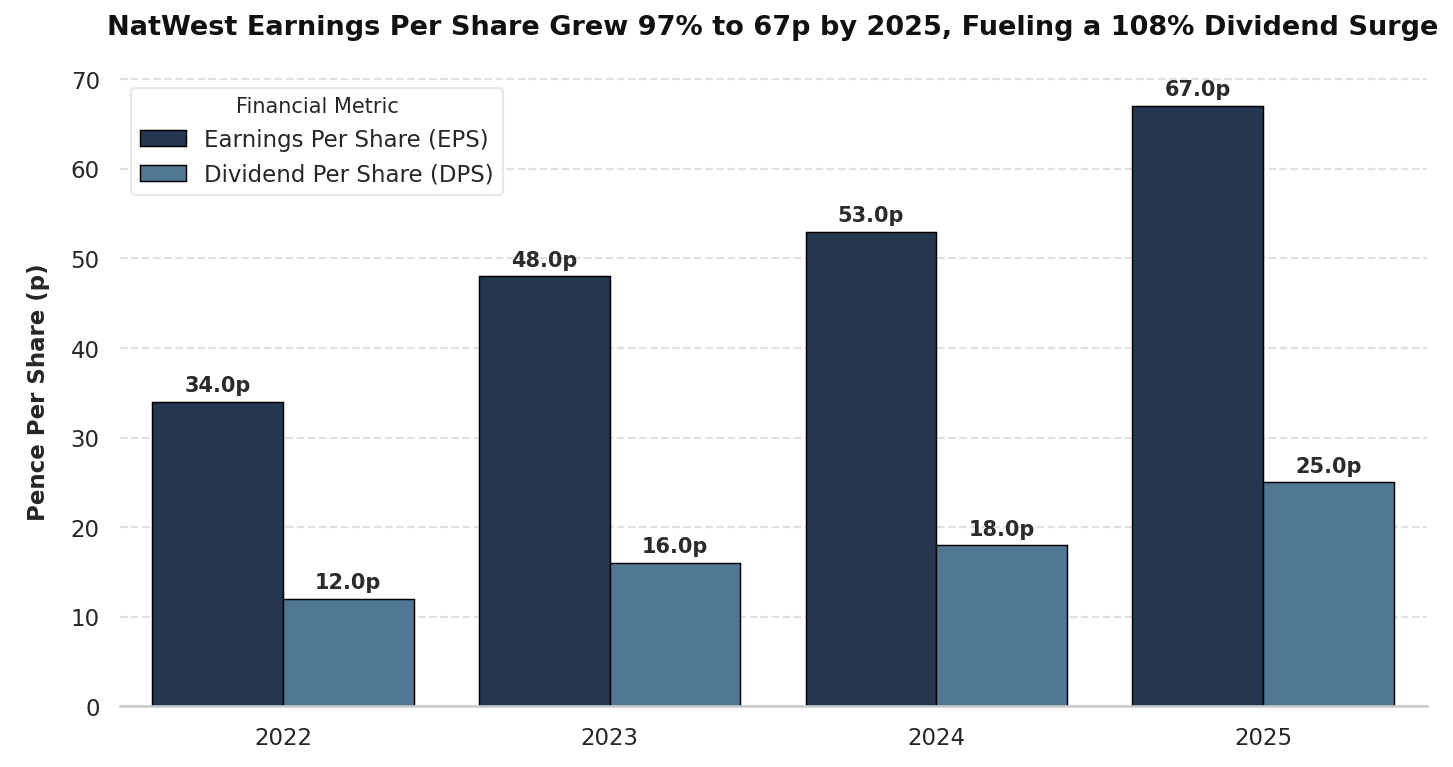
- 2022: Net income grew to £3.589 billion, EPS rose to 34p (£0.34), and the bank distributed a total dividend per share of 12p (£0.12). The business maintained a highly conservative dividend cover of 3.06x, meaning its earnings were more than three times the size of its dividend payout, representing a fortress-like level of security.
- 2023: Profitability climbed further, with net income hitting £4.636 billion and EPS reaching 48p (£0.48). The bank increased its total dividend per share to 16p (£0.16), representing a massive 31% growth rate from the previous year. This proved that the post-economic bounce was not a flash in the pan.
- 2024: Net income climbed to £4.802 billion, EPS reached 53p (£0.53), and the total dividend per share was boosted to 18p (£0.18). Shareholders enjoyed an incredible annual stock return of 91.25% as the market finally woke up to the bank's underlying earnings power.
- 2025: This was a landmark year. Natwest recorded an exceptional net income of £5.831 billion and a diluted EPS of 67p (£0.67). The total dividend distributed to shareholders surged to 25p (£0.25) per share. This represented an astonishing 43% dividend growth in a single year, supported by a healthy dividend cover of 2.70x.
Is Natwest's Dividend Safe And Sustainable For The Long Run?
As a dividend investor, your number one threat is a "dividend cut." There is nothing disheartening than buying a stock because it promises an 8% yield, only for the company to announce three months later that it is slashing its payout in half because it cannot afford it. This is what we call a "yield trap"... a stock that looks incredibly attractive on paper but is actually a financial landmine. So, how do we evaluate whether Natwest's dividend is safe? We do this by examining two primary safety valves... the dividend cover ratio and the bank's underlying balance sheet strength.1. Dividend Cover Ratio
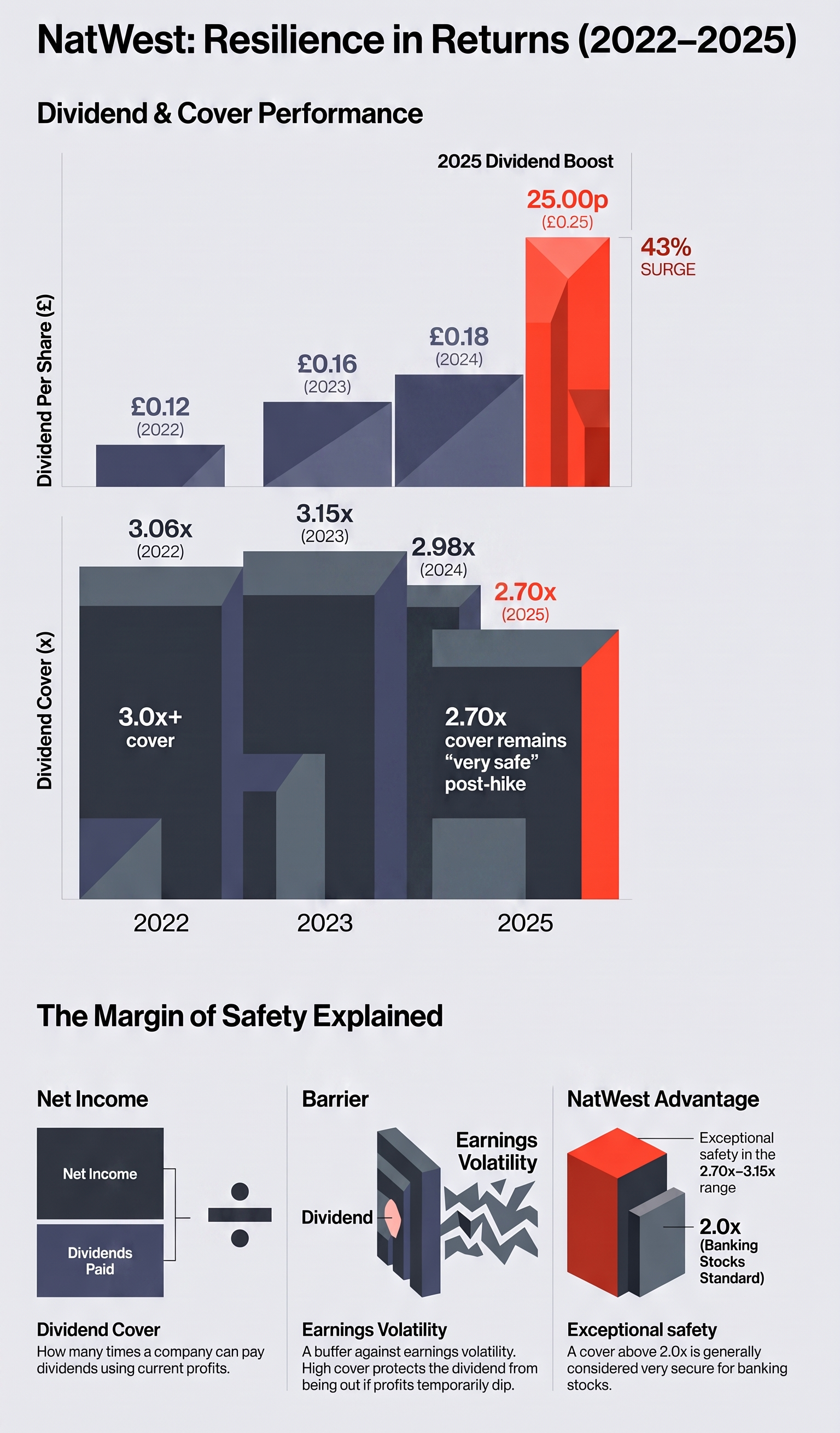
The first safety valve is dividend cover ratio. This is a simple ratio that compares a company's net earnings to the amount of money it pays out in dividends. Think of it like your personal household budget. If your monthly take-home salary is £3,000, and your essential living expenses are £1,000, your "income cover" is 3.0x. You have a massive £2,000 safety cushion. If your car breaks down or your energy bill spikes, you can easily absorb the cost without stressing. But if your living expenses are £2,900, your cover is just 1.03x. The slightest bump in the road will send you into financial distress. In corporate terms, a dividend cover of 2.0x is generally considered the gold standard of safety. It means the company earns twice as much as it distributes, leaving plenty of cash to reinvest in the business or survive a temporary downturn. Let's review Natwest's dividend cover history:- In 2022, the dividend cover was a highly comfortable 3.06x.
- In 2023, it stood at 3.15x.
- In 2024, it was 2.98x.
- In 2025, even after boosting the dividend by 43% to 25p (£0.25), the dividend cover remained a very safe 2.70x.
2. Balance Sheet Strength
The second safety valve is the balance sheet. Banks are highly regulated institutions. In the UK, the regulators monitor a bank's capital ratios to ensure they have enough of a cushion to withstand a major economic downturn. As of 2025, Natwest's balance sheet is incredibly strong, boasting total assets of £714.5 billion and total equity of £42.613 billion. This is a far cry from the fragile capital position of 2008. Also, Natwest's business model is highly focused. Around 90% of its total income is derived from the UK, meaning it is not exposed to highly volatile, speculative international investment banking activities. It is a boring, stable high-street bank that takes in deposits, lends out mortgages, and collects fees. For a dividend investor, "boring" is beautiful. Boring businesses pay consistent, reliable dividends year after year.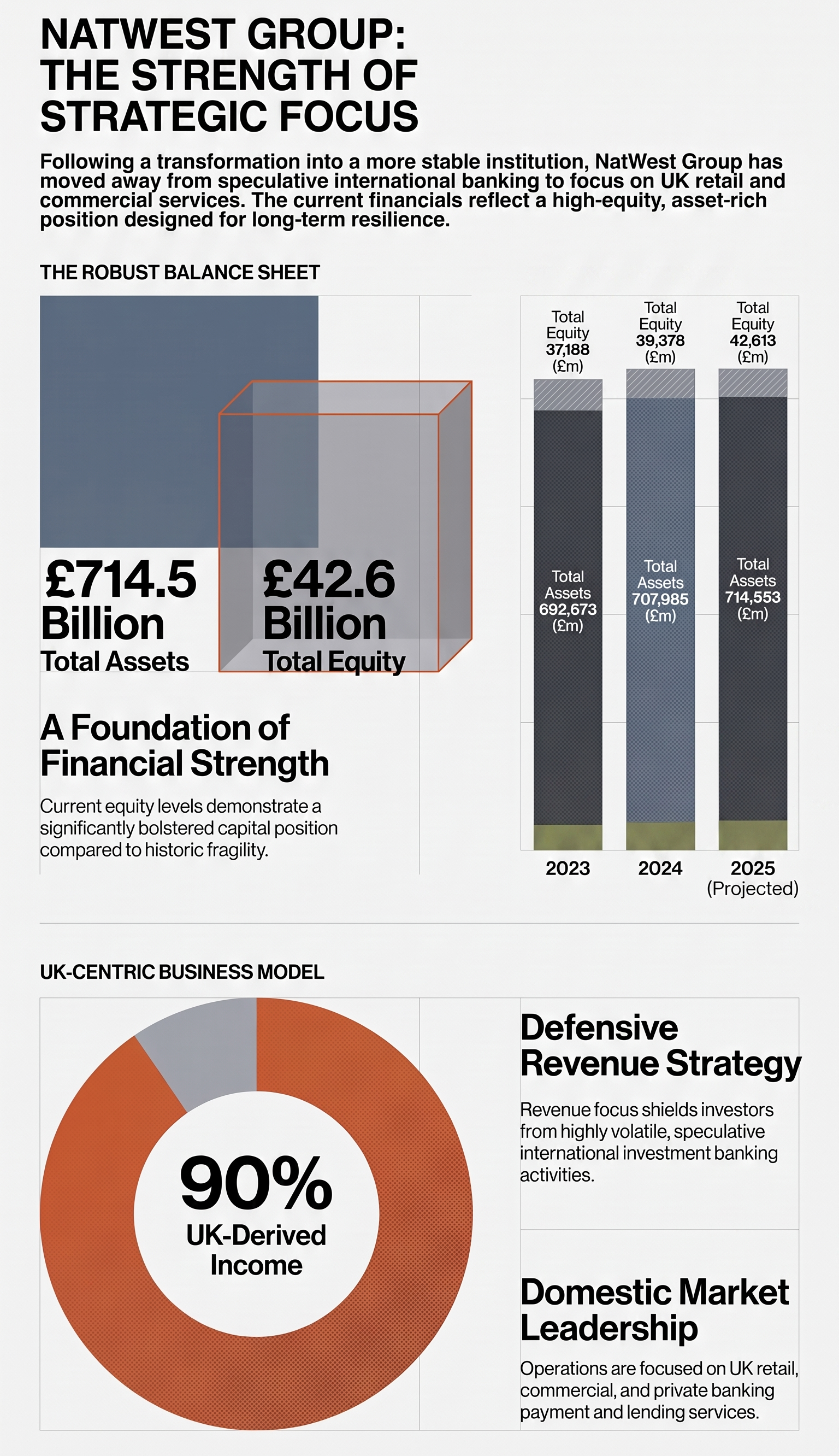
How Do Share Buybacks Supercharge Natwest's Dividend?
Many beginner investors focus entirely on the dividend yield and completely ignore a company's share buyback programme. This is a massive blunder. Share buybacks are the silent partner of dividend distributions, working behind the scenes to compound your wealth. To understand how share buybacks work, let's use a simple pizza analogy. Imagine you and three friends buy a large, eight-slice pepperoni pizza. Because there are four of you, everyone gets exactly two slices. This pizza represents the company's total earnings, and your slices represent your dividend payout. Now, imagine that one of your friends decides they are full and wants to go home. Before leaving, the remaining three of you pool your money to buy back that friend's share of the pizza. Now, there are only three of you left at the table. When the next eight-slice pizza arrives, how many slices do you get? You now get 2.67 slices! The pizza did not get any bigger, but because there are fewer people sharing it, your portion of the pie automatically increased. This is exactly what happens during a share buyback. When Natwest uses its excess cash to purchase its own shares on the open market, it cancels those shares. So, the total number of shares in circulation shrinks. This has two incredible benefits for you as a remaining shareholder:- Earnings Per Share (EPS) Rises Automatically: Because the total profit is divided among fewer shares, your earnings per share increase even if the bank's total net income remains flat. We saw this clear trend in Natwest's financials, where diluted EPS rose from 27p (£0.27) in 2021 to 67p (£0.67) in 2025.
- Future Dividends Become Cheaper For The Bank To Pay: Because there are fewer shares outstanding, the bank has to spend less total cash to maintain or increase its dividend per share. This makes Natwest's dividend much more sustainable and easier to grow in the future.
Why Should You Reinvest Your Natwest Dividend To Compound Wealth?
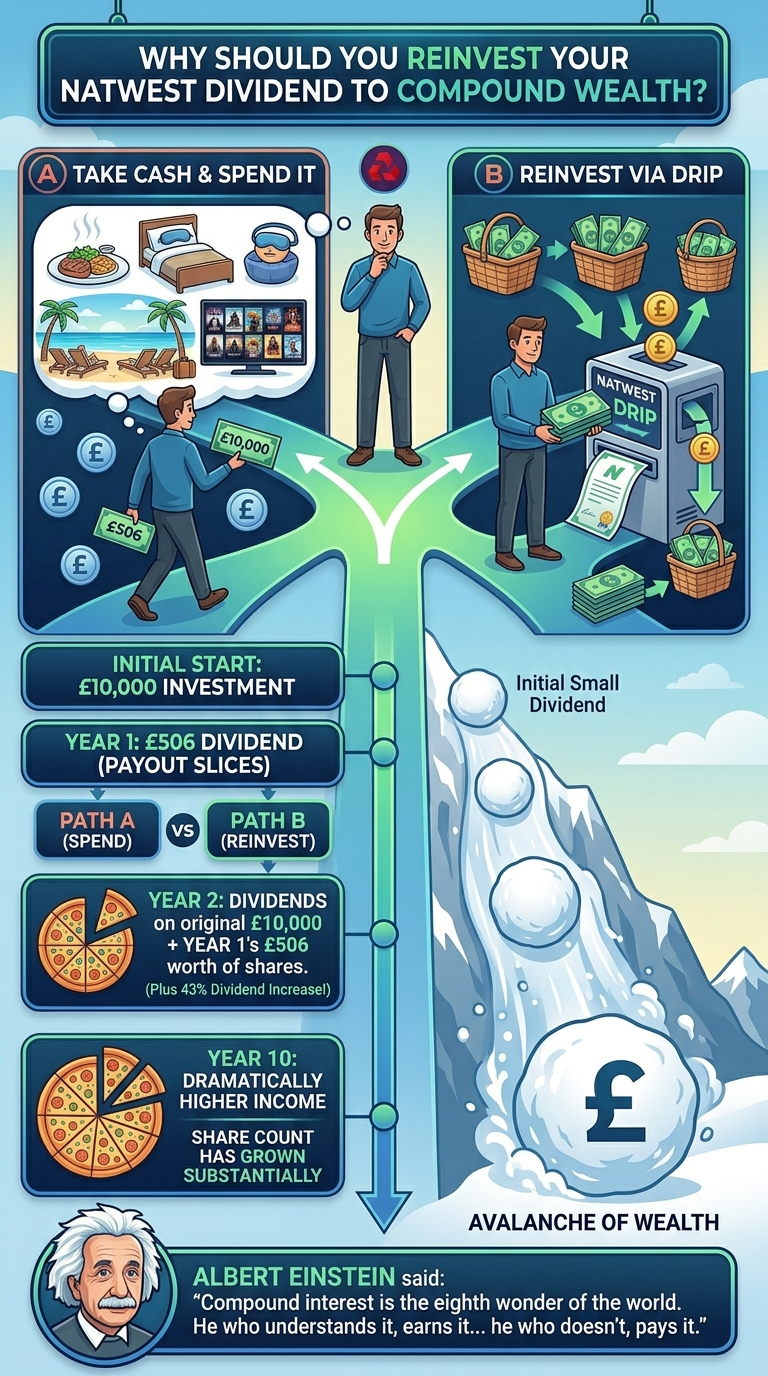
Now that we have established that Natwest's dividend is a powerful cash generator, we must address the most critical decision you will make as an investor... ...what should you do with the cash when it lands in your account? You have two options. Option A is to take the cash and spend it. You can buy a nice dinner, pay for a weekend getaway, or cover your monthly streaming subscriptions. There is absolutely nothing amiss with this after all, the ultimate goal of investing is to fund your lifestyle. However, if you do not need that income immediately to cover your bills, Option B is where the true financial magic happens. Option B is to use a dividend reinvestment plan (DRIP) to automatically use your cash dividends to buy more shares of Natwest. Reinvesting your dividends is the financial equivalent of building a snowball at the top of a snowy mountain. When you first pack a handful of snow and roll it along the ground, it gains very little size. It feels slow, and you might wonder why you are bothering. But as you keep rolling it, the snowball gets wider. Crucially, the larger the snowball becomes, the more surface area it has to collect even more snow with every single turn. By the time it reaches the bottom of the mountain, it has transformed into a massive, unstoppable avalanche of wealth. When you reinvest your dividends, you are using your "payout slices" to buy more "pizza shares."- In Year 1, your £10,000 investment pays you £506 in dividends. You reinvest that cash to buy more shares.
- In Year 2, you do not just get paid dividends on your original £10,000; you also get paid dividends on the extra £506 worth of shares you acquired in Year 1. Plus, if the bank increases its dividend distribution per share (as it did by 43% in 2025), your payout grows even faster.
- By Year 10, your share count has grown substantially, and your annual dividend income is dramatically higher than your initial payout all without you ever adding another penny of your own savings.
How Does Bank Deregulation And Ring-Fencing Affect Natwest's Dividend?
To get a complete picture of the bank's investment case, we also need to look at how government rules and financial regulations shape its destiny. For a long time after the 2008 financial downturn, British banks were kept on a very tight leash. One of the most significant rules was "ring-fencing," which encouraged UK high-street banks to completely separate their retail banking business (which takes care of ordinary consumers and small businesses) from their investment banking division (which takes part in riskier global trading). While ring-fencing was designed to protect taxpayers from another bank bailout, it also acted as a bit of a straightjacket. It restricted how the banks could use their cash and where they could expand. But recently, we have seen some exciting changes in the wind. The UK government and financial regulators have begun easing some of these ring-fencing rules, allowing banks to be more flexible with their capital. For example, on 25 August 2026, a major news story broke: "Natwest to boost presence in US after ring-fencing rules eased". This is a fantastic development for anyone interested in Natwest's dividend. By being allowed to expand its presence in the United States, Natwest can tap into new, high-growth markets that were previously off-limits. This geographic expansion allows the bank to diversify its earnings away from being 90% dependent on the UK. If Natwest can successfully grow its commercial and corporate footprint in the US, it will create a brand-new stream of profits. And as we know, more profits mean a larger pool of net income, which ultimately flows directly back to you in the form of an even bigger and more secure dividend distribution. This regulatory relief is like giving a runner a lighter pair of shoes... it helps them move faster and go further, which is excellent news for long-term income seekers.How Can You Start Investing For A Natwest Dividend In The UK?
If you have read this far, you are likely feeling excited about the prospect of building your own dividend-paying portfolio. But how do you actually turn this knowledge into action? Fortunately, starting your journey as a dividend investor in the UK is incredibly simple and highly accessible. First, you need to open an investment account. In the UK, you have several options, but for most retail investors, a Stocks & Shares ISA (Individual Savings Account) is the absolute best place to start. Why? Because a Stocks & Shares ISA acts as a powerful legal tax shield. Any dividends you receive and any capital gains you make inside the ISA are completely, 100% free from UK tax. You can invest up to £20,000 each tax year, and the taxman cannot touch a single penny of your returns. If you are saving specifically for retirement, you might also consider a SIPP (Self-Invested Personal Pension), which offers tax relief on your contributions but locks your money away until you reach retirement age. For general, unlimited investing, a standard Dealing Account is also an option, though you may be subject to dividend and capital gains taxes if you exceed your annual personal tax-free allowances. Once you have chosen and opened your account with a reputable UK broker which offers low-cost dealing and automated dividend reinvestment, the steps are straightforward:- Deposit Funds: Transfer cash from your bank account into your new investment account.
- Search for the Stock: Type in the company name "Natwest Group" or use its unique ticker symbol NWG.
- Place Your Order: Decide how many shares you want to buy or how much money you want to invest. You can choose a standard instant trade, or set up a regular monthly investment plan to buy shares gradually over time.
- Select Your Reinvestment Preference: Remember to toggle the "dividend reinvestment" or DRIP setting if you want your payouts to automatically purchase more shares.
Frequently Asked Questions About Natwest's Dividend
What is the current estimated yield of Natwest's dividend?
As of August 2026, the estimated dividend yield for Natwest Group PLC is 5.06%, offering an attractive stream of passive income compared to historical market averages.
When was the most recent ex-dividend date for the interim Natwest dividend in 2026?
The ex-dividend date for the 2026 interim dividend was 13 August 2026. To receive this dividend, shares had to be purchased before this date.
How much is the 2026 interim Natwest dividend payment?
The bank declared an interim dividend payment of 12p (£0.12) per share for the first half of 2026.
When is the payment date for the 2026 interim Natwest dividend?
The 2026 interim dividend is scheduled to be paid to eligible shareholders on 18 September 2026.
How often does Natwest distribute its dividend payments?
Natwest Group PLC typically pays its dividend twice a year: a smaller interim dividend in September and a larger preliminary/final dividend in April or May.
What was the total Natwest dividend paid for the fiscal year 2025?
For the fiscal year ending 31 December 2025, the total dividend per share distributed was 25p (£0.25), up from 18p (£0.18) in 2024 and 16p (£0.16) in 2023.
What is the dividend cover ratio for Natwest's dividend, and is it safe?
The dividend cover ratio for 2025 was a highly comfortable 2.70x. This means earnings were 2.7 times larger than the dividend payout, leaving a massive safety cushion.
Can I automatically reinvest my Natwest dividend to buy more shares?
Yes. You can set up a dividend reinvestment plan (DRIP) through your UK broker to automatically buy fractional shares with your cash distributions, harnessing the power of compound returns.
Does the UK government's stake impact share buybacks and Natwest's dividend?
Yes. The government has been reducing its stake through directed buybacks, where Natwest uses excess cash to buy back and cancel government-owned shares, boosting the value and long-term security of the remaining dividends.
How can I receive Natwest's dividend completely tax-free?
By purchasing your shares through a tax-sheltered Stocks & Shares ISA, all received dividends and capital gains are completely exempt from UK tax.
| 💡 Key Takeaways |
|---|
| Natwest's dividend is a strong source of UK passive income, offering a handsome estimated dividend yield of 5.06%. |
| In 2025, the bank demonstrated incredible financial performance, boosting its full-year dividend payment by 43% to 25p (£0.25) per share. |
| To secure the payouts, you must buy shares before the ex-dividend date, such as the 13 August 2026 date for the upcoming 12p (£0.12) interim dividend. |
| The bank's dividend history shows a remarkable turnaround from financial downturn nationalisation to a highly profitable dividend champion. |
| Safety is high, with a highly secure 2025 dividend cover of 2.70x, meaning profits comfortably exceed distributions. |
| Ongoing share buybacks, including directed buybacks from the UK government, reduce share count and structurally boost earnings per share. |
| A dividend reinvestment plan (DRIP) automates the purchase of additional shares, unlocking the compounding returns snowball. |
| Regulatory easing of ring-fencing rules has enabled Natwest to expand into the US, opening new growth pathways to support Natwest's dividend. |
| UK residents can use a tax-free Stocks & Shares ISA to hold Natwest (NWG) shares and shield all dividend payouts from taxes. |
| The golden rule of income investing remains diversification; avoid concentration risk by spreading your capital across multiple stock sectors. |