Rio Tinto Dividend:
How To Get Paid Regularly
From A Global Mining Giant
I remember the first time I looked at Rio Tinto's dividend.
The yield was higher than my savings account, the company was a global giant, and the idea of being paid simply to own shares felt like a clever way to build income. But I also knew one truth... a high yield can be a warning sign, not a gift. So let's walk through the current numbers and see whether Rio Tinto's dividend deserves a place in your income portfolio.The quick answer is this... as of 2026, Rio Tinto's dividend offers a 4.55% dividend yield, a $3.68 dividend per share, a 1.65x dividend cover, and $2.8 billion free cash flow behind it.
That combination looks solid for income today, but because Rio Tinto is a mining company, the payment is tied to commodity prices and can change.What Is Rio Tinto's Dividend?
Think of a dividend as your share of a company's profit paid back to you in cash. When you buy shares in Rio Tinto, you become a part-owner of one of the world's largest mining groups.
The company digs up iron ore, aluminium, copper and other materials used all over the planet. When it makes money, the board can decide to return some of that cash to shareholders.Rio Tinto's dividend is normally paid twice a year.
You receive an interim dividend part-way through the year and a final dividend after the full-year results. This matters because you are not waiting 12 months for one lump sum. You get a regular income stream, which is exactly what many dividend investors want.I like to compare a dividend to a landlord collecting rent. Rio Tinto owns productive assets mines, railways, ports and processing plants that generate cash.
As a shareholder, you effectively own a tiny slice of those assets. The dividend is your rent cheque.Rio Tinto's Dividend Yield: What Does That Mean?
The dividend yield is the annual dividend expressed as a percentage of the share price.
If Rio Tinto's dividend is $3.68 per share and the share price is around $80.88, then the yield is about 4.55%.Here is the simple maths...
For every £1,000 you invest, a 4.55% yield would generate about £45.50 a year in dividends before costs and taxes.
That is not guaranteed, but it gives you a baseline to compare against a savings account, a bond or another FTSE 100 dividend share.One thing I always remind myself... the yield moves every day. If the share price falls, the yield rises. If the share price rises, the yield falls.
A high yield can simply mean the share price has dropped because investors are worried. That is why you should never buy a stock on yield alone.Is The Yield Good For A UK Income Investor?
Compared with the average FTSE 100 yield, which has often sat around 3.5% to 4%, a 4.55% Rio Tinto's dividend yield is above average. For someone seeking passive income, that can look attractive.
But mining companies are cyclical. Their earnings rise and fall with the global economy. A high yield today could be followed by a dividend cut tomorrow if iron ore and copper prices fall.
I would rather own a slightly lower but more dependable yield than a high yield that is not covered by real cash.Rio Tinto's Dividend Per Share: What It Means For Your Pocket
The dividend per share is simply the total cash you receive for each share you own over a year. At $3.68 per share, if you owned 500 Rio Tinto shares, your annual income would be $1,840 before any currency conversion or tax.
Because Rio Tinto reports in US dollars, as a UK investor buying Rio Tinto shares on the London Stock Exchange it means you will receive your dividend in pounds sterling.
The amount you receive depends on the exchange rate at the time the dividend is converted. A depreciated pound means you may get a little more sterling for each US dollar. A stronger pound means you get a little less.I always check the exchange rate because it can quietly change your real income. A 5% move in sterling can make a noticeable difference over a full year.
How Often Does Rio Tinto Pay Its Dividend?
Rio Tinto's dividend is typically paid twice a year. There is an interim payment announced with half-year results and a final payment announced with full-year results. The exact dates vary, but the rhythm is predictable.
For UK investors, this twice-yearly schedule is useful. It means you receive cash in two instalments, which can help with budgeting or reinvesting.
Some investors prefer quarterly payers, but many FTSE 100 companies, including Rio Tinto, stick to semi-annual payments.Dividend Cover: Is Rio Tinto's Dividend Safe?
Dividend cover tells you how easily a company can pay its dividend from its earnings. A cover of 1.65x means Rio Tinto earned $1.65 for every $1.00 it paid out in dividends. That is a comfortable cushion.
Think of it like your personal finances. If you earn £1,650 a month after tax and your rent is £1,000, your cover is 1.65 times.
You have £650 left over for food, bills and savings. That feels manageable. If your rent were £1,600, your cover would be only 1.03x, and you would be stretched.A dividend cover below 1.0x means a company is paying out more than it earns, which is usually unsustainable.
A cover of 1.65x gives Rio Tinto room to absorb depreciated commodity prices before the dividend is at risk.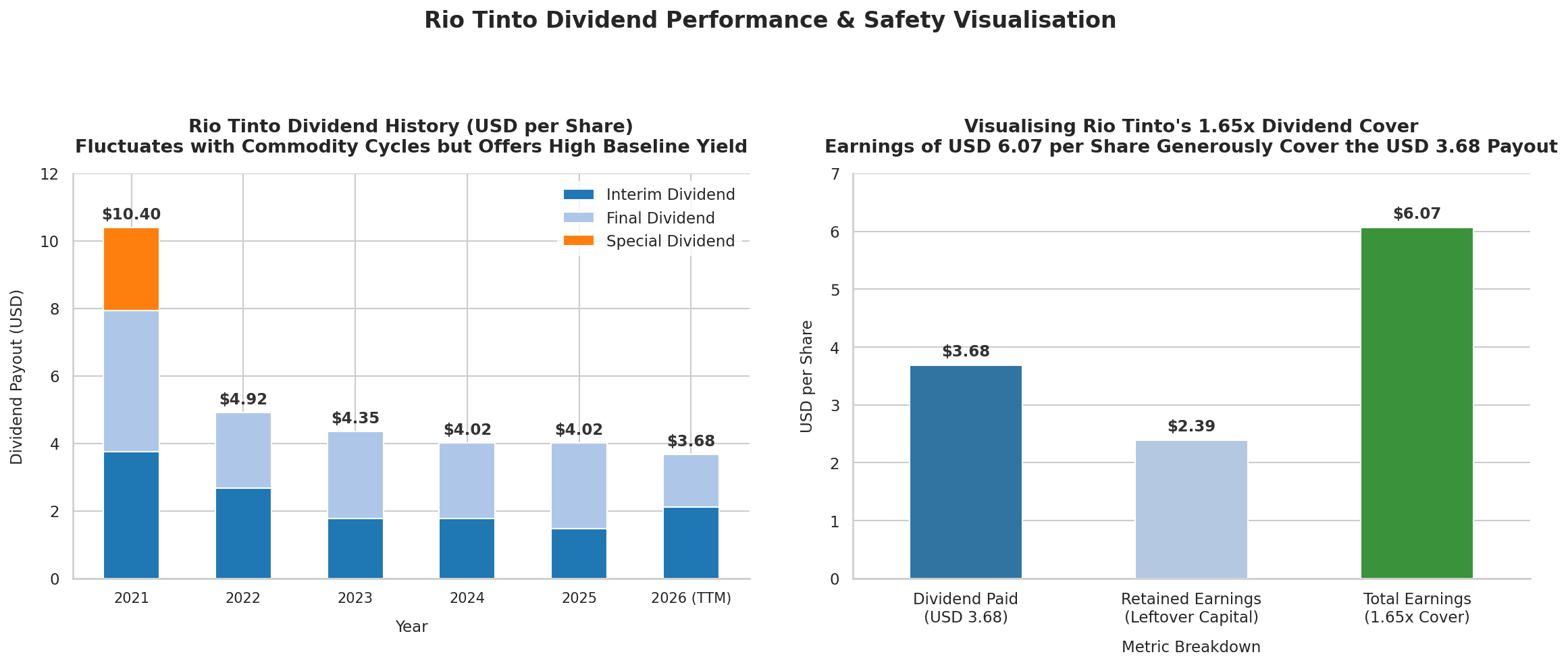
What Is A Good Dividend Cover For Mining Stocks?
For mining stocks, I like to see a cover above 1.5x when times are good. Miners are cyclical, so they need a buffer because profits can fall quickly.
A cover of 1.65x is not bulletproof, but it is healthier than many high-yield shares that operate on a cover of 1.0x or less.It is also worth looking at the payout ratio, which is the flip side of dividend cover. A cover of 1.65x is the same as a payout ratio of about 61%.
That means Rio Tinto pays out around 61% of earnings as dividends and keeps 39% to reinvest in the business or strengthen the balance sheet. I find that balanced.Free Cash Flow: The Engine Behind Rio Tinto's Dividend
Earnings can sometimes be flattered by accounting adjustments, but free cash flow is the actual cash generated after paying for mines, equipment and other essential spending.
As of 2026, Rio Tinto reported $2.8 billion free cash flow. This matters because dividends are paid in cash, not in accounting profit. If a company reports strong profits but has meager cash flow, it may need to borrow to pay the dividend. That is a red flag. Rio Tinto's free cash flow shows real money coming in the door.I use a simple mental model... free cash flow is the salary that lands in your bank account after all your bills are paid.
You can only spend what actually arrives. A company can only sustainably pay dividends from cash that actually arrives.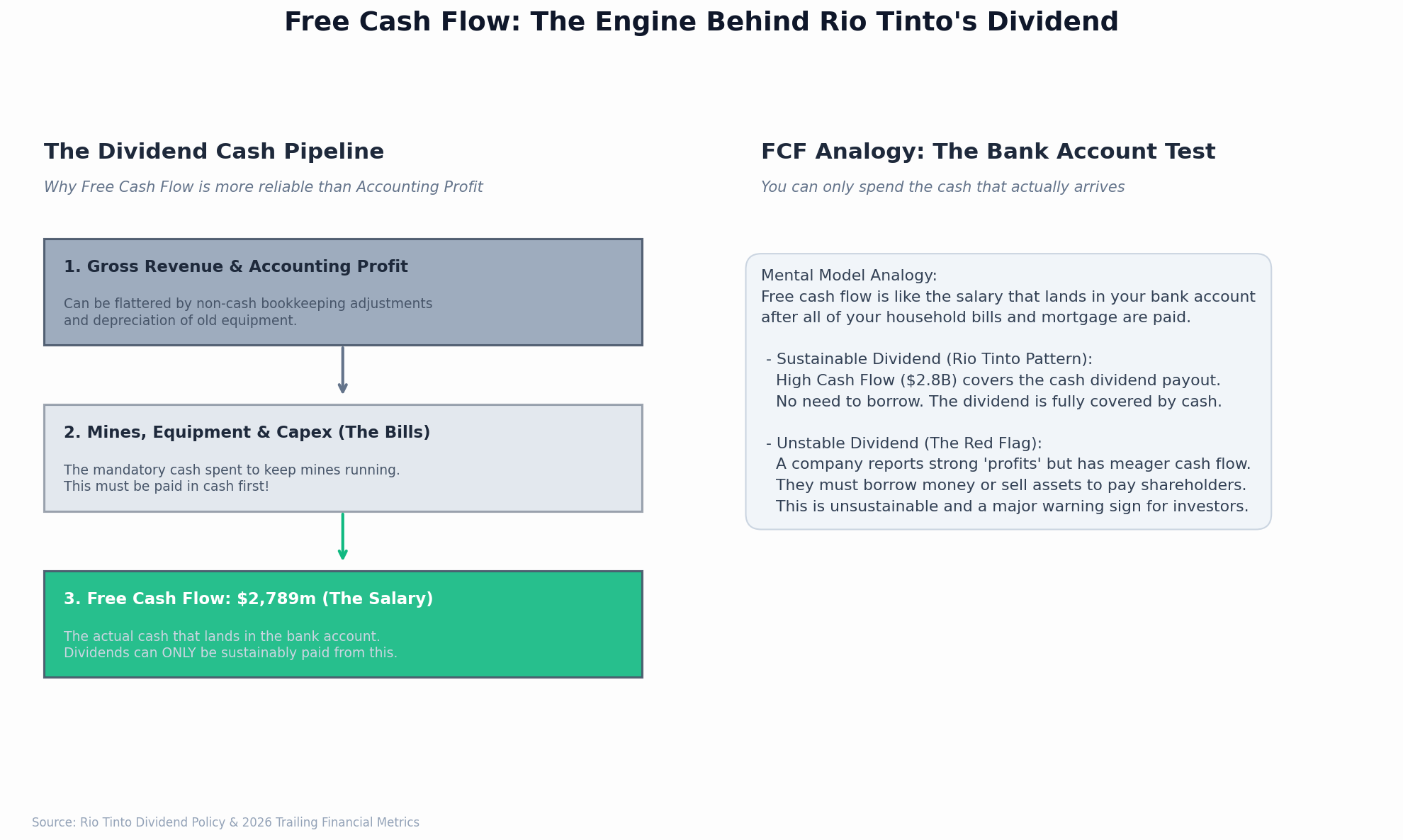
Does Free Cash Flow Cover Rio Tinto's Dividend?
To check this, I compare total dividends paid with free cash flow.
If Rio Tinto paid roughly $7.5bn to $8bn in dividends across the year, and free cash flow was $2.8 billion in a reported period, I need to be careful about which period I am looking at. Free cash flow can be measured quarterly, half-yearly or annually.The key point is not to fixate on a single number in isolation. I look at the trend. If free cash flow is consistently above total dividend payments over a full year, the dividend has room to breathe.
If free cash flow is consistently below dividends, the dividend may be living on borrowed time.How Commodity Prices Affect Rio Tinto's Dividend
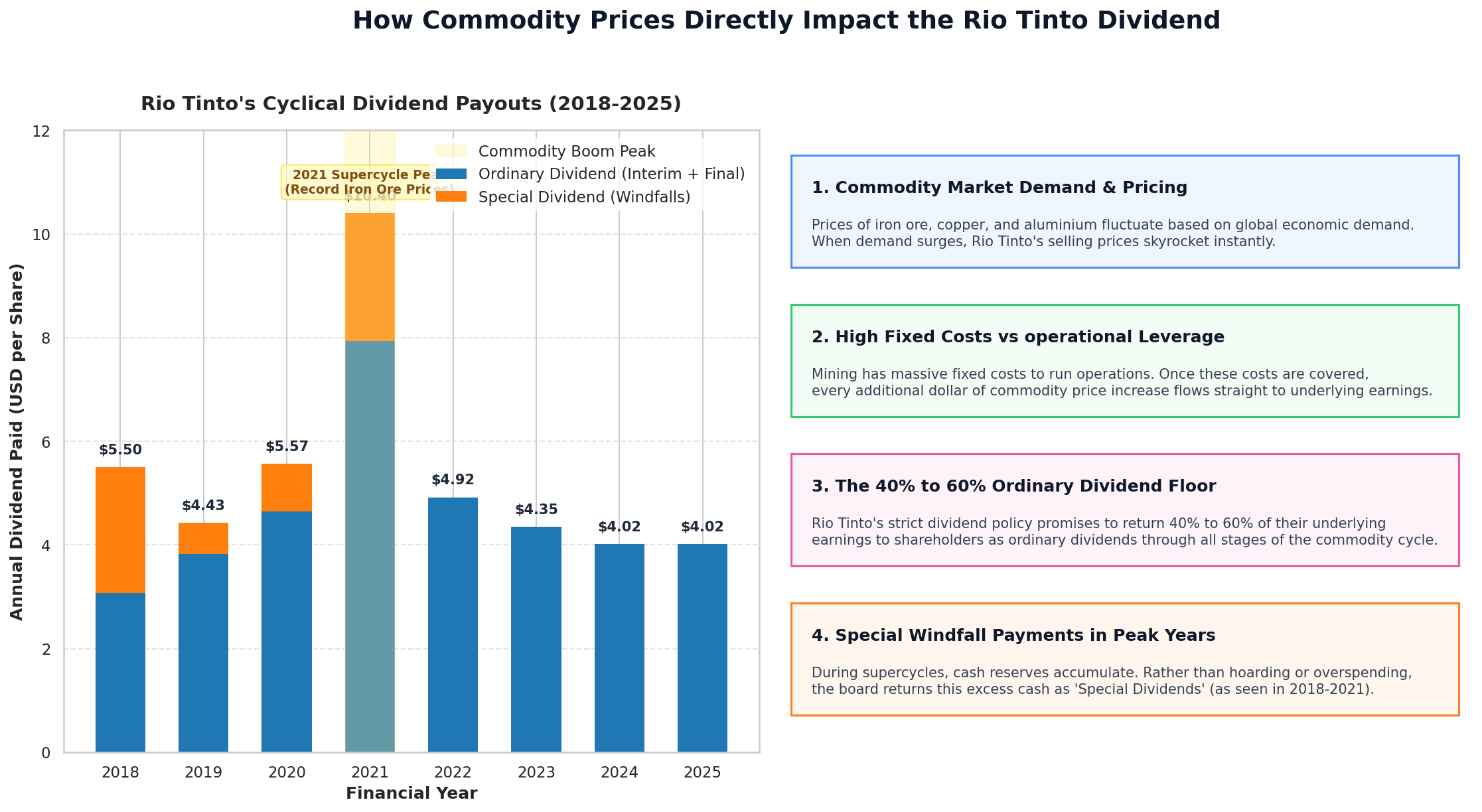
Rio Tinto is one of the largest iron ore producers in the world. It also mines copper, aluminium and other minerals. The prices of these commodities directly determine how much profit Rio Tinto makes.
When global construction and manufacturing boom, iron ore and copper prices rise. Rio Tinto earns more, generates more cash, and can pay a larger dividend.
When the global economy slows, commodity prices fall, cash flow shrinks, and the dividend may be cut.I think of it like a farmer. In a good year with high crop prices and good weather, the farmer earns a bumper profit and can set aside cash.
In an unfavourable year with low prices and drought, income falls sharply. You would not expect the farmer to pay the same dividend in the lean year as in the good year.That is the reality of mining stocks. Rio Tinto's dividend is not a fixed bond coupon. It moves with the cycle.
What Happened To Rio Tinto's Dividend In Previous Downturns?
History is a useful teacher. During periods of falling commodity prices, Rio Tinto has reduced or rebased its dividend. In the 2015-2016 mining downturn, many miners cut payouts sharply.
More recently, Rio Tinto has tied its dividend more closely to earnings, meaning payouts rise in good years and fall in lean years.As an income investor, I do not ignore this history. A 4.55% dividend yield can look great, but if the underlying earnings halve, the dividend could halve too.
That would turn your 4.55% yield into a much lower yield on your original cost.Is Rio Tinto A Good Dividend Stock For Passive Income?
If you are looking for passive income, Rio Tinto's dividend has several attractive qualities. It is supported by a diversified mining business, a strong balance sheet, and a policy of returning cash to shareholders.
The 1.65x cover and $2.8 billion free cash flow suggest the dividend is sound.However, it is not the same as a utility or consumer staples company. Those businesses sell essential goods and services every day, rain or shine.
Rio Tinto sells commodities whose prices can swing sharply. So I view it as a higher-yield but higher-risk income share.For a diversified income portfolio, I would not put all my capital into any single miner. I might hold Rio Tinto alongside other dividend payers from different sectors to smooth out the ups and downs.
How Does Rio Tinto Compare To Other FTSE 100 Dividend Shares?
Within the FTSE 100, Rio Tinto is one of the larger mining stocks. It often sits alongside BHP, Glencore and Anglo American.
Each miner has a different mix of commodities and a slightly different dividend policy.Compared with more defensive FTSE 100 dividend payers such as consumer goods, financials or utilities, Rio Tinto offers a higher yield but more volatility.
The trade-off is simple... more potential income today, but a greater chance that income falls tomorrow.I always ask myself whether I need that extra yield enough to accept the extra risk. For some investors, the answer is yes.
For others, a lower yield with more stability is better.Rio Tinto Dividend Dates: Ex-Dividend Date And Payment Date
To receive Rio Tinto's dividend, you need to own the shares before the ex-dividend date. The ex-dividend date is the cut-off point.
Buy before that date, and you qualify for the upcoming payment. Buy on or after it, and you do not.I like to think of the ex-dividend date like a guest list for a party. If your name is on the list before the doors close, you get in.
If you arrive after the doors close, you miss out. The dividend payment date is simply when the cash is sent to your account.For UK investors, Rio Tinto announces the ex-dividend date, record date and payment date for each interim and final dividend.
These dates are published on the company's investor relations page and through the London Stock Exchange.Why Does The Share Price Fall On The Ex-Dividend Date?
On the ex-dividend date, the share price often falls by roughly the amount of the dividend. This is not a loss of value.
It simply reflects that new buyers are no longer entitled to the upcoming cash payment.If the dividend is $1.84 and the shares trade at $80.00, the price may open around $78.16 on the ex-dividend date. The value has not disappeared... it has simply been transferred from the share price to the cash you will receive.
I find this reassuring because it prevents a free lunch. If shares did not adjust, everyone would buy just before the ex-dividend date, collect the dividend and sell immediately for a guaranteed profit.
Rio Tinto's Dividend Reinvestment: Can You Compound Your Income?
One of the most powerful ways to build wealth with Rio Tinto's dividend is to reinvest it. Many UK brokers and platforms offer a dividend reinvestment plan, sometimes called a DRIP.
Instead of receiving cash, your dividend automatically buys more Rio Tinto shares.I like the analogy of a snowball rolling down a hill. Each reinvested dividend buys more shares. Those extra shares then earn their own dividends.
Over time, the snowball grows larger without you adding any new money. The effect is modest in year one but can become significant over ten or twenty years. If Rio Tinto's dividend remains steady and the share price does not fall permanently, reinvesting can meaningfully boost your total return.Should You Reinvest Rio Tinto's Dividend Or Take The Cash?
There is no single right answer. If you are retired and need income to pay bills, taking the cash makes sense.
If you are still building your portfolio and do not need the income today, reinvesting can accelerate compounding.I have used both approaches at different times. During my accumulation years, I reinvested almost everything.
Later, when I wanted income, I switched to taking cash. The right choice depends on your personal goals.How To Buy Rio Tinto Shares
UK investors can buy Rio Tinto shares on the London Stock Exchange. The ticker is usually RIO. You can buy shares through a Stocks And Shares ISA, a SIPP, or a general investment account.
Buying within a Stocks And Shares ISA is popular because dividends and capital gains are sheltered from UK tax. A SIPP offers similar tax advantages for retirement savings.
A general account gives you no tax shelter, but it is still simple to open.I always check the dealing charges and foreign exchange fees before choosing a broker. Small differences in fees can eat into your dividend income over many years.
Can You Hold Rio Tinto In An ISA or SIPP?
Yes. Rio Tinto is a UK-listed share, so it is eligible for a Stocks And Shares ISA and a SIPP. This is a big advantage for UK dividend investors because it means Rio Tinto's dividend can be received free from UK income tax on dividends when held inside an ISA.
In a SIPP, the tax treatment is also favourable. You receive tax relief on contributions, and dividends and capital gains grow free from UK tax within the pension wrapper.
The rules can change, so I always suggest checking the latest HMRC guidance.Tax On Rio Tinto Dividends
Outside a tax shelter, UK dividend income is subject to income tax. The UK has a dividend allowance each tax year, which lets you receive a certain amount of dividend income tax-free.
Above that allowance, dividends are taxed at your marginal dividend rate. The rates depend on whether you are a basic, higher or additional rate taxpayer. Because Rio Tinto's dividend is paid in US dollars and converted to sterling, you still report the sterling value on your tax return if you hold shares outside an ISA or SIPP.I am not a tax adviser, so I cannot give personal tax advice. But the general principle is clear... using a Stocks And Shares ISA can protect your dividend income from UK tax.
Risks To Rio Tinto's Dividend Every Investor Should Know
No dividend is guaranteed. The main risks to Rio Tinto's dividend come from lower commodity prices, higher operating costs, geopolitical events, and changes in global demand for steel and copper.
Iron ore is Rio Tinto's biggest profit driver. China is the world's largest consumer of iron ore because it produces vast amounts of steel.
If Chinese construction slows or steel demand falls, iron ore prices can drop quickly. That would reduce Rio Tinto's earnings and potentially its dividend.Other risks include operational challenges at mines, environmental regulations, and currency movements.
Because Rio Tinto reports in US dollars but operates in many countries, exchange rates can influence profits.How Can You Manage The Risk of A Dividend Cut?
I use two practical strategies. First, I diversify across sectors. I would not rely on any single miner for all my dividend income.
Second, I size my position sensibly. Even a high-quality company can disappoint, so I avoid putting too much of my portfolio into one share.I also keep an eye on the payout ratio and free cash flow. If the cover falls below 1.5x and free cash flow declines sharply, I start asking tougher questions.
A deteriorating cover can be an early warning sign.Why I Still Find Rio Tinto's Dividend Interesting
Despite the risks, I still find Rio Tinto's dividend interesting for income investors who understand cyclical businesses.
The 4.55% yield is above many FTSE 100 peers. The 1.65x cover provides a safety buffer. The $2.8 billion free cash flow shows real money behind the payout.Mining is not going away. The world needs iron ore for steel, copper for electrification, and aluminium for transport and packaging.
Rio Tinto owns high-quality assets with long mine lives. That gives it the potential to pay dividends for decades.But I would never treat it like a bond. I would monitor commodity prices, free cash flow and the payout ratio. If the fundamentals stay healthy, the income can be rewarding.
How To Evaluate Rio Tinto's Dividend For Your Portfolio
Here is a simple checklist I use before buying any dividend share, including Rio Tinto...
- Dividend Yield: Is the yield high enough to meet my income goal, but not so high that it signals financial strain?
- Dividend Per Share: Is the payment realistic given the company's earnings and cash flow?
- Dividend Cover: Is the cover above 1.5x for a cyclical business?
- Free Cash Flow: Is free cash flow consistently above total dividend payments?
- Payout Ratio: Is the company retaining enough cash to reinvest and protect the business?
- Industry Outlook: Are commodity prices likely to remain supportive over the next few years?
What Does The Free Cash Flow Really Tell You?
Let me break down the $2.8 billion free cash flow in plain terms. Free cash flow is the cash left after a company pays for its mines, equipment, exploration and other essential investments.
It is the money available for dividends, debt reduction or share buybacks.When I see a company generating billions in free cash flow, I know it has real financial strength. It does not need to borrow heavily to maintain its dividend. That gives me confidence as an income investor.
However, I also remember that free cash flow can be volatile for miners. A single quarter can be affected by weather, maintenance shutdowns or a sudden fall in iron ore prices.
That is why I look at full-year figures rather than one quarter.Rio Tinto's Shareholder Returns: Dividends And Buybacks
Rio Tinto returns cash to shareholders in two main ways... dividends and share buybacks. Dividends give you cash directly.
Buybacks reduce the number of shares in circulation, which can increase earnings per share and support the share price over time.As an income investor, I focus mainly on dividends because they put cash in my account. But I also appreciate buybacks because they signal that management believes the shares are good value and that the balance sheet is strong.
When a company can pay a healthy dividend and still buy back shares, it often means shareholder returns are a priority. That is generally positive for long-term owners.
Iron Ore And Rio Tinto's Dividend: The Core Relationship
If there is one commodity to watch, it is iron ore. Rio Tinto's Pilbara operations in Western Australia produce vast quantities of iron ore at a relatively low cost.
The profit margin on those tonnes drives a large share of group earnings.When iron ore prices are high, Rio Tinto's profit and free cash flow surge. When prices fall, the reverse happens.
Rio Tinto's dividend is therefore closely linked to the iron ore price, even though copper and aluminium also matter.I keep a simple rule... before buying or holding a mining dividend share, check the main commodity price chart. If iron ore is near cyclical lows, expect dividend pressure.
If it is near highs, expect strong payouts but also be aware that prices can fall.How Does Copper Fit Into Rio Tinto's Dividend Story?
Copper is becoming more important for Rio Tinto because the world needs copper for grid infrastructure. While iron ore remains the biggest profit driver today, copper offers long-term growth potential.
For dividend investors, this is useful diversification within a single company. A strong copper price can partly offset a fallen iron ore price.
That said, copper is also cyclical, so it does not remove the volatility entirely.I like businesses that have more than one meaningful profit stream. It reduces the chance that a single commodity downturn destroys the dividend.
What Would Make Me Worry About Rio Tinto's Dividend?
I am not paid to be a cheerleader. I want to be honest about what would worry me. The main warning signs would be...
- A sharp and sustained fall in iron ore and copper prices.
- Dividend cover dropping below 1.5x.
- Free cash flow turning negative.
- Rising debt levels.
- Large project cost overruns.
- A change in dividend policy that removes the link to earnings.
Can Rio Tinto's Dividend Grow Over Time?
Mining dividends are not known for steady annual increases like some consumer staples. Instead, they tend to move in cycles.
Rio Tinto's policy has been to pay a base dividend plus additional returns when conditions are strong. That means the total payment can grow rapidly in good years and fall in uncertain years.Over the long term, if commodity demand rises and Rio Tinto keeps costs under control, the dividend could grow. But you should not expect a smooth upward line. The path will be bumpy.
I focus on the average dividend across a cycle rather than any single year. That gives me a more realistic view of the income I might receive.
Rio Tinto Dividend: My Personal Checklist Before Investing
Here is how I would think about Rio Tinto's dividend today...
- Yield: 4.55% - Above average for the FTSE 100, but not extreme.
- Dividend Per Share: $3.68 - Meaningful income per share.
- Dividend Cover: 1.65x - A comfortable buffer.
- Free Cash Flow: $2.8 billion - Real cash generation.
- Main Risk: Commodity price declines.
- Main Strength: Low-cost, high-quality mining assets.
Final Thoughts On Rio's Tinto Dividend
I hope this has made Rio Tinto's dividend easier to understand. The 4.55% yield, $3.68 dividend per share, 1.65x cover and $2.8 billion free cash flow paint a picture of a company that can pay income today.
But the mining cycle means that income can move.If you are building passive income and you understand commodity cycles, Rio Tinto could play a role in your portfolio. If you want a perfectly steady payment every year, you may be disappointed.
The key is to know what you own, why you own it, and how much risk you are willing to accept.I always remind myself that the best dividend investor is not the one who chases the highest yield, but the one who understands the business behind the payout.
With Rio Tinto, that business is strong, but it is not immune to the global economy.Before acting, check the latest ex-dividend dates, company announcements and your own tax position. And remember, this is educational information, not personal financial advice.
What is Rio Tinto's dividend yield as of 2026?
As of 2026, Rio Tinto's dividend yield is 4.55%. This is calculated by dividing the annual dividend per share of $3.68 by the share price. The yield changes daily as the share price moves.
How much is Rio Tinto's dividend per share?
Rio Tinto's dividend per share is $3.68 on an annual basis as of 2026. UK investors receive the payment in pounds sterling, so the exact amount depends on the exchange rate at the time of payment.
Is Rio Tinto's dividend covered by earnings?
Yes. The dividend cover is 1.65x, meaning Rio Tinto earned $1.65 for every $1.00 paid out as dividends. This provides a comfortable safety buffer for the current payment.
What is the free cash flow behind Rio Tinto's dividend?
Rio Tinto reported $2.8 billion free cash flow as of 2026. Free cash flow is the cash left after essential spending, and it is the real source of dividend payments.
How often does Rio Tinto pay dividends?
Rio Tinto typically pays dividends twice a year: an interim dividend and a final dividend. The interim is announced with half-year results, and the final is announced with full-year results.
What is the ex-dividend date for Rio Tinto's dividend?
The ex-dividend date is the cut-off date you must own shares before to receive the upcoming dividend. If you buy on or after the ex-dividend date, you will not receive that payment.
Can I hold Rio Tinto shares in a UK Stocks And Shares ISA?
Yes. Rio Tinto is a UK-listed share on the London Stock Exchange, so it is eligible for a Stocks And Shares ISA and a SIPP. Holding shares in an ISA can protect dividend income from UK tax.
Is Rio Tinto's dividend safe in a commodity downturn?
The dividend is safer than many high-yield mining shares because of the 1.65x cover and strong free cash flow, but it is not guaranteed. Iron ore and copper prices can fall, which would reduce earnings and potentially the dividend.
Does Rio Tinto offer dividend reinvestment?
Many UK brokers offer a dividend reinvestment plan for Rio Tinto shares. Instead of receiving cash, your dividend buys more shares automatically, which can help compound your income over time.
Is Rio Tinto a good dividend stock for passive income?
Rio Tinto can be a good dividend stock for passive income if you understand commodity cycles. The 4.55% yield is attractive, but the payment can rise and fall with mining profits, so it is best held as part of a diversified portfolio.
| 💡 Key Takeaways |
|---|
| Rio Tinto's dividend yield is 4.55% as of 2026, which sits above the average FTSE 100 dividend yield and gives UK income investors a meaningful starting return. |
| Rio Tinto's dividend per share is $3.68, paid in two instalments each year, so you receive regular cash rather than waiting a full 12 months. |
| Dividend cover of 1.65x means Rio Tinto earned $1.65 for every $1.00 paid out, giving the payout a comfortable safety buffer even if commodity prices soften. |
| Free cash flow of $2.8 billion shows genuine cash generation behind the dividend, not just accounting profit, which is exactly what I look for as an income investor. |
| Rio Tinto's dividend is cyclical and closely tied to iron ore and commodity prices, so payments can rise in good years and fall in lean ones. |
| A 4.55% dividend yield is attractive for passive income, but a high yield can also signal higher risk, so it should never be bought on yield alone. |
| UK investors can hold Rio Tinto shares in a Stocks And Shares ISA or SIPP, which can shelter the dividend from UK income tax and help your income compound faster. |
| The ex-dividend date is the cut-off point for receiving the next payment, so always check the calendar before buying to avoid missing out. |
| Dividend reinvestment lets you use Rio Tinto's payout to buy more shares automatically, turning a simple income stream into a long-term compounding machine. |
| Rio Tinto's dividend is best treated as a higher-yield, higher-risk income share, and it works most sensibly as part of a diversified dividend portfolio rather than a single holding. |